How Long It Typically Takes to Learn to Drive in Bromley
 Learning to drive is a significant milestone, offering a newfound sense of independence and freedom. For residents of Bromley, the journey from novice to licensed driver is a process influenced by a multitude of factors. While there’s no single definitive answer to how long it takes to learn to drive in Bromley, understanding the typical timeline and the elements that shape it can help manage expectations and plan your learning effectively. If you’re embarking on this exciting adventure, a well-structured driving school, such as EL’s Driving School, can provide the guidance and tailored instruction you need to navigate the roads of Bromley with confidence.
Factors Influencing Learning Duration
The time it takes to master the art of driving is not a fixed entity. It’s more akin to a river, its flow dictated by the landscape through which it travels. Each individual’s learning trajectory is unique, shaped by a confluence of personal attributes, practical considerations, and the learning environment.
Prior Experience and Aptitude
Some individuals possess a natural inclination towards driving, finding the coordination and decision-making processes intuitive. Others may require more time to develop these skills.
Innate Motor Skills
The ability to smoothly operate a vehicle – steering, clutch control, gear changes – is a physical skill. Individuals with good hand-eye coordination and spatial awareness may find these aspects come more easily.
Cognitive Abilities
Driving demands a considerable amount of cognitive processing. This includes hazard perception, multitasking (checking mirrors, scanning junctions, operating controls), and rapid decision-making. Those who excel at these mental gymnastics tend to progress faster.
Previous Exposure to Vehicles
Even if an individual has never formally driven, prior exposure to being a passenger, observing drivers, or even familiarisation with a stationary vehicle can provide a subtle head start. Understanding basic mechanics or the functions of controls can demystify aspects of driving for some learners.
Frequency and Intensity of Lessons
The more time you dedicate to practicing and learning, the quicker you are likely to become proficient. Sporadic lessons can feel like trying to fill a leaky bucket – progress is slow and often reversed.
Regularity of Practising
Consistent, scheduled lessons are crucial. Aiming for at least one lesson per week, and ideally more during the initial stages, helps to embed learning and prevent skills from fading. Think of it as watering a plant; consistent hydration leads to robust growth.
Duration of Lessons
While shorter, more frequent lessons can be beneficial for initial skill acquisition, longer lessons (e.g., 1.5 to 2 hours) can be more effective for consolidating learning, tackling more complex manoeuvres, and experiencing different driving conditions without interruption.
Intensive Courses vs. Standard Learning
 Intensive driving courses, where a significant number of hours are packed into a short period (e.g., one to two weeks), can accelerate learning for some. However, this approach demands high concentration and can be overwhelming for others. A more gradual, standard approach, spread over several weeks or months, allows for more assimilation of information.
Type of Vehicle and Transmission
The type of car you learn in and its transmission (manual or automatic) can influence the learning curve.
Manual vs. Automatic Transmission
Learning to drive a manual car typically takes longer than learning an automatic. Mastering clutch control and gear changes requires significant practice and coordination, adding a layer of complexity that is absent in an automatic vehicle. Many learners find the process of synchronising clutch, accelerator, and gear changes to be the most challenging aspect of manual driving. Automatic cars, by contrast, handle gear changes themselves, allowing the learner to focus more intently on steering, speed control, and hazard perception.
Vehicle Size and Handling
The size and handling characteristics of the learning vehicle can also play a role. Larger vehicles or those with a less responsive steering system might require more adjustment and practice compared to a smaller, more agile car.
Learning Environment and Road Conditions
Bromley, like any urban and suburban area, presents a diverse range of driving conditions that can impact learning.
Urban vs. Rural Driving Skills
Bromley encompasses both busy town centres and quieter residential streets. Learning to navigate complex urban environments with heavy traffic, pedestrian activity, and intricate junctions requires a different skillset than driving on less congested rural roads. Developing confidence in both environments is essential.
Specific Bromley Road Features
Bromley has its share of challenging road features, such as roundabouts, one-way systems, dual carriageways (approaching the A2 and M25, for example), and busy traffic lights. Familiarity with these specific local challenges is part of the learning process. Getting to grips with the timing of traffic lights on roads like the A2022 or navigating the traffic flow around Bromley South station requires dedicated practice.
Weather Conditions
Learning to drive in adverse weather conditions – rain, fog, ice – adds another dimension to the challenge. While it is not advisable for a complete novice to face severe weather alone for their first few lessons, experiencing different conditions under the guidance of an instructor is vital for developing adaptable driving skills. Ice and snow, while less frequent in Bromley than in more northerly regions, can still significantly alter road grip and braking distances.
If you’re considering learning to drive in Bromley, you might find it helpful to explore the advantages of learning to drive an automatic vehicle. This approach can often simplify the learning process and may reduce the time it takes to become a confident driver. For more insights on this topic, check out the article on the benefits of automatic driving lessons at Advantages of Learning to Drive Automatic.
The Typical Learning Timeline
While individual progress varies, statistical data and general consensus provide a benchmark for what can be considered a typical learning period. These are averages, and it is important to remember that exceeding these timelines does not indicate a lack of capability.
Average Number of Hours
The Driving and Vehicle Standards Agency (DVSA) in the UK suggests that the average learner driver requires around 45 hours of professional instruction and an additional 20 hours of private practice to reach test standard. This brings the total to approximately 65 hours.
Breakdown of Practice Hours
This total comprises a gradual progression through various driving skills. Initial hours might focus on basic control, moving on to manoeuvres, then venturing into more complex road scenarios.
Beginner Stages (First 10-15 Hours)
- Vehicle Control: Clutch control, steering, braking, accelerating.
- Starting and Stopping: Smoothly moving off and stopping the car.
- Basic Junctions: Approaching, emerging from simple junctions.
- Mirror Checks: Developing the habit of checking mirrors for situational awareness.
Intermediate Stages (15-35 Hours)
- Gear Changes: Smooth and timely gear selection.
- Roundabouts: Navigating multi-lane and complex roundabouts.
- Emerging from Complex Junctions: Dealing with obscured visibility and faster traffic.
- Independent Driving: Following road signs and Sat Nav instructions.
- Manoeuvres: Parallel parking, bay parking, pulling up on the right.
Advanced Stages and Test Preparation (35+ Hours)
- Hazard Perception: Identifying potential dangers and reacting appropriately.
- Dual Carriageways and Motorway Practice (if applicable): Developing skills for higher speed driving.
- Emergency Stops: Practising braking techniques in a controlled environment.
- Mock Tests: Simulating the actual driving test to build confidence and identify weaknesses.
Time Span in Weeks and Months
Translating these hours into a timeframe requires consideration of lesson frequency.
Weekly Lesson Schedules
- One lesson per week: If each lesson is 1 hour, it would take approximately 65 weeks (over a year) to accumulate 65 hours of professional tuition. This typically doesn’t include private practice.
- Two lessons per week: This would reduce the time to approximately 32.5 weeks (around 8 months).
Intensive Courses
Intensive courses can condense this significantly. A 30-hour intensive course might be completed in one week, followed by further practice and potentially a test. However, this is often for individuals who have some prior experience or a natural aptitude.
Factors Affecting Test Readiness
Even after accumulating sufficient hours, a learner may not feel ready for their test. Several factors contribute to this.
Confidence Levels
Confidence is a major hurdle for many. Overcoming nervousness and feeling assured in your ability to handle various driving situations is paramount. Mock tests and repeated practice on challenging routes help build this confidence.
Test Nerves
The pressure of the driving test itself can cause even competent drivers to make mistakes. Learning to manage these nerves through relaxation techniques and extensive preparation is a key part of the process.
Instructor’s Assessment
Your driving instructor’s professional judgment is the most reliable indicator of your readiness. They will assess your ability to drive safely, independently, and to the standard required by the DVSA.
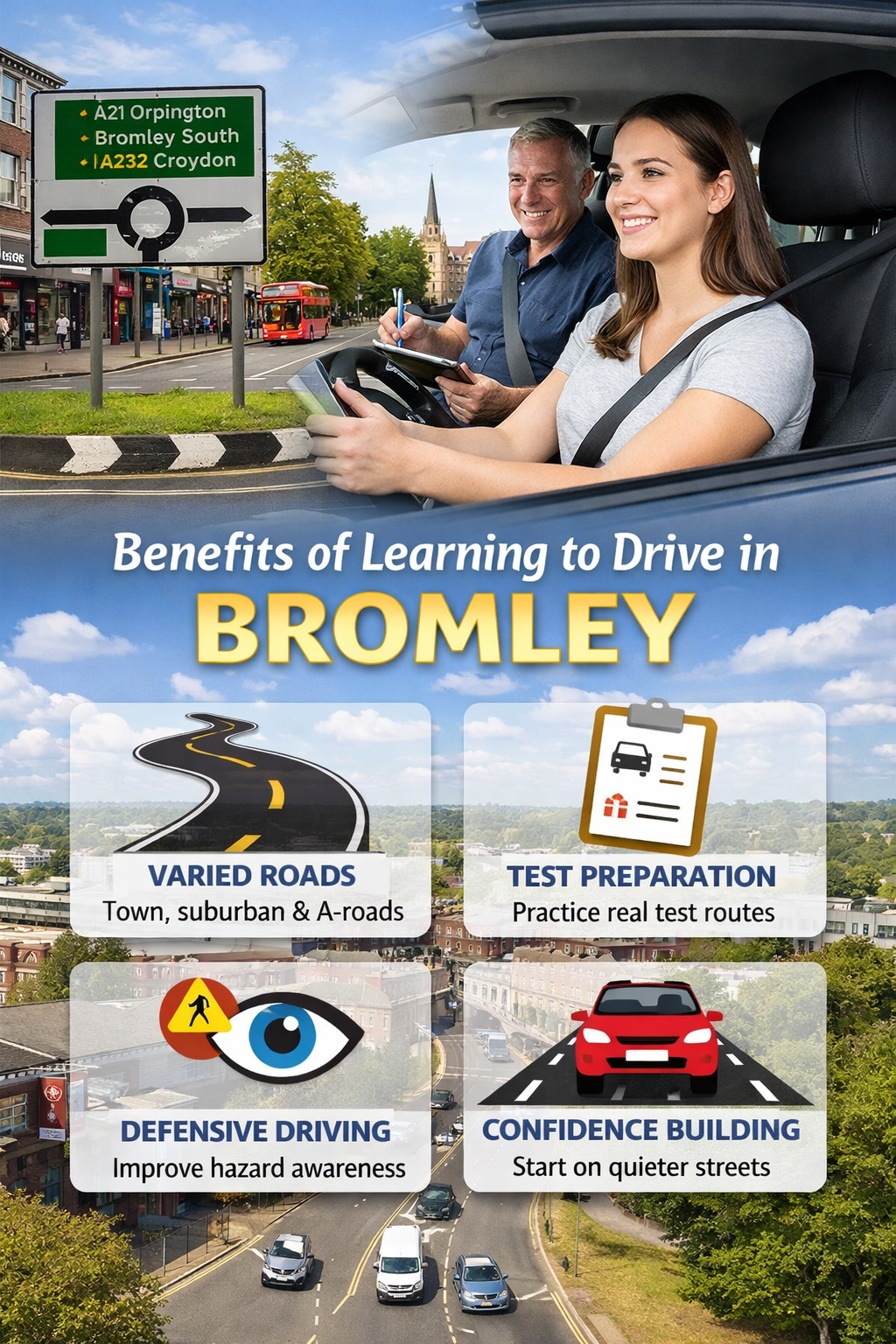
Learning to Drive in Bromley: Specific Considerations
Bromley presents a unique set of environmental and traffic conditions that influence the learning process. Understanding these can help learners anticipate challenges and focus their practice accordingly.
Bromley’s infrastructure includes a mix of busy main roads and quieter residential areas, each presenting distinct learning opportunities.
Main Arterial Roads
Roads like the A21, A222 (Widmore Road), and parts of the A2022 are characteristic of busy urban driving. Learners will need to develop proficiency in navigating higher speed limits, multi-lane junctions, traffic lights, and observing traffic patterns of a larger volume of vehicles.
Roundabouts and Traffic Lights
Bromley has numerous substantial roundabouts, such as the one at the Crofton Road/Orpington High Street junction, and complex multi-phase traffic light systems on major routes. Mastering these involves understanding signalling, lane discipline, and anticipating the movements of other road users.
Residential Streets
 The many residential streets in areas like Bickley, Bromley Common, and Sundridge Park offer a contrasting learning environment. Here, learners will practice lower-speed control, dealing with parked cars, blind junctions, and pedestrian activity. These quieter roads are excellent for developing fine motor control and observation skills.
Parking and Manoeuvres
Residential streets are ideal for practicing essential manoeuvres like parallel parking, bay parking, and three-point turns, where space and less immediate traffic pressure are advantageous.
Interaction with Local Traffic and Pedestrians
Bromley is a densely populated area, meaning interaction with other road users and pedestrians is a constant factor.
Pedestrian Crossings and Cycle Lanes
The presence of numerous pedestrian crossings (pelican, puffin, zebra) and dedicated cycle lanes requires constant vigilance and adherence to traffic regulations. Learners must be adept at spotting pedestrians and cyclists, anticipating their movements, and yielding when necessary.
School Zones and Busy Shopping Areas
Areas around schools and the main shopping hub in Bromley town centre will experience high levels of pedestrian traffic, particularly during peak hours. Learners need to develop heightened awareness and a cautious approach in these zones.
Public Transport and Traffic Congestion
Bromley is served by an extensive public transport network, which contributes to the volume of traffic on its roads.
Bus Routes and Trams
The prevalence of bus routes, including trams in some adjacent areas, means learners will frequently encounter buses, which can obstruct visibility and require careful overtaking or following.
Congestion Hotspots
Certain times of day and specific locations within Bromley can experience significant traffic congestion. Learning to drive defensively, maintain a safe distance, and anticipate potential stoppages is crucial for navigating these common occurrences.
Factors That Can Slow Down Learning
While the goal is to learn efficiently, several common pitfalls can extend the learning period. Being aware of these can help learners and instructors mitigate them.
Inconsistent or Infrequent Lessons
As mentioned earlier, infrequent lessons are like trying to build a house with intermittent deliveries of bricks. The momentum is lost, and earlier lessons may need to be revisited, thus extending the overall time.
Gaps Between Lessons
If more than a week passes between lessons, especially in the early stages, learners may forget essential techniques or feel hesitant to re-engage with them. This leads to a need for constant recapping.
Stopping and Starting the Learning Process
Taking extended breaks from driving lessons, perhaps due to personal commitments or financial reasons, can significantly prolong the time it takes to pass. It is akin to a runner stopping mid-race; they have to expend extra energy to get back up to speed.
Lack of Private Practice
While professional instruction is vital, supplementary private practice is invaluable for reinforcing what is learned in lessons.
Insufficient Practice Time
Many learners underestimate the amount of practice needed. Driving is a skill that improves with repetition and exposure to varied situations. Without this, progress can stagnate.
Practicing Only ‘Easy’ Routes
If private practice is confined to familiar, quiet roads, learners will not gain experience in more challenging situations, potentially making them feel less prepared for the test.
Poor Learning Habits or Mindset
Certain habits or mental blocks can hinder progress, irrespective of the number of hours logged.
Fear and Anxiety
Driving anxiety is a common barrier. If not addressed effectively, it can prevent learners from fully engaging with the learning process and taking necessary risks (within safe boundaries).
Overconfidence or Complacency
Conversely, some learners may become overconfident too quickly, leading to a reduction in careful observation or a tendency to overlook instructions. This can result in bad habits forming, which are harder to correct later.
Inability to Accept Feedback
Not being receptive to constructive criticism from an instructor can mean that persistent errors are not corrected, thereby slowing down overall development.
Ineffective Instruction or Instructor Fit
The relationship between a learner and their instructor is crucial. An unsuitable instructor can impact motivation and the pace of learning.
Mismatched Learning Styles
If the instructor’s teaching style does not align with the learner’s preferred way of absorbing information, the learning process can be inefficient.
Lack of Clear Explanations
If instructions are vague or explanations are not clear, learners may struggle to understand concepts, leading to confusion and repeated mistakes.
When considering how long it usually takes to learn to drive in Bromley, it’s also important to understand the various conditions that can affect driving skills. For instance, learning to navigate safely in challenging weather, such as fog, is crucial for any new driver. You can find valuable tips on this topic in the article about how to drive safely in foggy conditions, which provides insights that can enhance your overall driving experience and preparedness.
Reaching Test Readiness: Signs and Milestones
Knowing when you are truly ready for your driving test is usually a combination of self-assessment and your instructor’s expert opinion.
Consistent Safe Driving
The most fundamental sign of readiness is the ability to consistently drive safely and adhere to all traffic laws without significant prompting from your instructor.
Independent Driving Proficiency
You should be able to drive independently for extended periods, making appropriate decisions regarding speed, lane changes, and navigation, using road signs and directions accurately.
If you are preparing for a test that involves independent driving using a Sat Nav, you should be comfortable with receiving and following its directions, while simultaneously maintaining full awareness of your surroundings and other road users.
Hazard Perception Skills
You should be demonstrating a good awareness of potential hazards, identifying them early, and reacting appropriately and safely. This includes anticipating the actions of other drivers, pedestrians, and cyclists.
Mastering Manoeuvres
The ability to perform all required manoeuvres correctly and safely, in a variety of locations and under different conditions, is a key indicator.
Executing Manoeuvres Smoothly
This means being able to carry out parallel parking, bay parking, and other required manoeuvres with precision, without excessive correction, and within a reasonable space, demonstrating control over the vehicle.
Performing Parked Car Assessment Manoeuvres
Your instructor will likely be looking for you to seamlessly integrate parking manoeuvres into your driving, showing a natural feel for the vehicle’s dimensions and trajectory.
Comfort and Confidence on the Road
Feeling generally comfortable and confident when driving is a strong sign of readiness.
Reduced Anxiety
While some nerves are normal, your overall anxiety levels should have significantly decreased. You should feel in control of the vehicle and the driving situation.
Ability to Adapt to Different Conditions
You should feel capable of handling various road and traffic conditions, including different times of day, moderate traffic levels, and potentially some less-than-ideal weather, without feeling overwhelmed.
The Role of Professional Driving Schools in Bromley
For learners in Bromley, a professional driving school offers a structured and expert-led approach to mastering the skills required for passing the driving test. Their expertise in local driving conditions and DVSA requirements is invaluable.
Structured Curriculum and Expertise
Reputable driving schools typically follow a curriculum designed to cover all aspects of the DVSA syllabus, ensuring comprehensive preparation.
Qualified Instructors
Instructors are not only trained in teaching driving but also in understanding individual learning needs. They can adapt their methods to suit different learners, from anxious beginners to those needing to refine specific skills.
Local Knowledge
Bromley-based instructors possess intimate knowledge of the local test routes and common challenges. They can guide learners through specific tricky junctions, roundabout configurations, and traffic patterns unique to the Bromley area. This localised expertise is a significant advantage.
Building Confidence and Reducing Anxiety
A supportive learning environment is crucial for building learner confidence.
Practice Test Simulation
Mock tests conducted by instructors can replicate the pressure of the actual test, helping learners to acclimatise and build resilience.
Encouraging and Constructive Feedback
Good instructors provide timely, constructive feedback, focusing on areas for improvement while also acknowledging strengths, which builds confidence and motivation.
Efficient Learning Path
With their experience, instructors can tailor lesson plans to accelerate learning, focusing on areas where a learner needs the most development.
Identifying Weaknesses Quickly
Experienced instructors can rapidly identify a learner’s weaknesses and provide targeted exercises to address them, preventing the formation of bad habits and saving time.
Maximizing Lesson Effectiveness
By structuring lessons logically and progressively, instructors ensure that each session contributes meaningfully to the learner’s development towards test readiness. They understand the “art of the possible” in driving instruction, guiding learners through complex concepts in manageable steps.
In conclusion, the journey to learning to drive in Bromley is a dynamic process. While an average learner may take around 45 hours of professional instruction and 20 hours of private practice, the actual timeframe is a personal tapestry woven with individual aptitude, dedication, and the specific learning environment. By understanding the influencing factors and seeking guidance from experienced professionals, you can navigate this process effectively and achieve your goal of becoming a confident and safe driver on the roads of Bromley.