Professional Driver Instruction Across Bromley
Embarking on the journey to gain your driving licence is a significant step, and for those residing in or around Bromley, securing proficient and practical driver training is paramount. This guide explores the landscape of practical driver education available, focusing on the essential elements that contribute to becoming a safe and confident driver. Learning to drive is less about mastering a machine and more about cultivating a responsible mindset, a perspective that experienced instructors diligently impart. For a comprehensive overview of driving school services in the area, you can read more here.
The initial stages of practical driver training are dedicated to building a robust understanding of the fundamental principles of driving. This phase is analogous to laying the bedrock of a house; without a strong foundation, the entire structure is compromised.
Vehicle Controls and Basic Operation
Before you even encounter moving traffic, you will become intimately familiar with the controls of the vehicle. This includes:
- Steering Wheel: Understanding how it translates your intentions into directional changes for the car. This involves mastering smooth turns, avoiding jerky movements that can unsettle the vehicle, and appreciating the feedback the wheel provides about the road surface. It is the primary interface through which you connect with the road’s contours.
- Accelerator and Brake Pedals: Learning the precise pressure required for nuanced control. The accelerator is your engine’s voice, dictating speed, while the brake is your guardian, allowing for controlled deceleration. Mastering the balance between these two is crucial for smooth progress and safe stopping.
- Clutch (for manual transmission): The delicate art of engaging and disengaging the engine from the gearbox. This requires a sensitive touch to avoid stalling, especially when moving off from a standstill or changing gears. It’s a rhythm that must be felt rather than simply learned by rote.
- Gear Selection: Understanding the appropriate gear for different speeds and road conditions. The gearbox is the car’s transmission system, allowing you to harness the engine’s power effectively. Selecting the right gear is akin to choosing the right tool for a specific task.
- Mirrors and Indicators: Learning to use these tools effectively for awareness and communication. Mirrors are your eyes in the back and sides, providing crucial spatial awareness. Indicators are your spoken word on the road, clearly communicating your intentions to other road users.
Starting and Stopping the Vehicle Safely
The initial actions of starting the engine and moving off from a stationary position are critical. Instructors will guide you through the correct sequence of operations:
- Pre-Drive Checks: A routine inspection of the vehicle, ensuring everything is in order before commencing your journey. This habit, instilled early, becomes second nature and contributes to overall safety.
- Tyre Pressures: Ensuring optimal inflation for grip and fuel efficiency.
- Fluid Levels: Checking oil, coolant, and screenwash.
- Lights and Signals: Verifying all lights are operational.
- Mirrors: Adjusting them to provide optimal visibility.
- Moving Off: The precise coordination of clutch, accelerator, and steering to commence movement without stalling or lurching. This is often the first hurdle for new drivers, and mastering it provides a significant confidence boost.
- Stopping Procedure: Gently applying the brakes and engaging the clutch at the appropriate moment to bring the vehicle to a smooth halt. This requires foresight and anticipation of traffic flow.
Understanding the Road Environment
Beyond the car itself, practical driver training emphasizes understanding the broader road environment. This involves developing situational awareness, a quality that allows a driver to anticipate potential hazards.
- Road Markings: Deciphering the meaning of lines, arrows, and symbols painted on the road surface. These are the road’s silent language, guiding your path and dictating your behaviour.
- Traffic Signs: Comprehending the directives and warnings conveyed by various signs. Each sign represents a rule or a piece of important information designed to ensure order and safety.
- Road Naming Conventions: While seemingly minor, understanding street names and how they are used for navigation is a practical aspect of driving.
For those interested in enhancing their driving skills through practical driver training across Bromley, it’s essential to understand the next steps if you happen to fail your driving test. A related article that provides valuable insights on this topic can be found at Failed Your Driving Test? What Next?. This resource offers guidance on how to prepare for a retake and improve your chances of success in the future.
Developing Essential Driving Maneuvers
Once the foundational elements are understood, practical driver training progresses to mastering a range of essential driving manoeuvres. These are the building blocks of confident and competent driving in various road situations.
Controlled Braking and Acceleration
The ability to modulate speed is a cornerstone of safe driving. This involves more than simply pressing pedals; it’s about understanding the forces at play and responding appropriately.
- Progressive Application: Gradually increasing or decreasing speed to match traffic flow and road conditions. This avoids abrupt changes that can surprise other road users.
- Emergency Braking: The rapid and effective application of brakes in a sudden, critical situation. This is a skill practiced in controlled environments to ensure a driver can react effectively when faced with unexpected events.
- Anticipatory Braking: Using the brake proactively when observing potential hazards ahead, rather than leaving it until the last moment. This reduces wear on the braking system and contributes to smoother, safer driving.
Effective Steering Techniques
Steering is not just about turning; it’s about controlled directional change, essential for navigating all types of roads and situations.
- Steering Wheel Control: Maintaining a firm but relaxed grip, using appropriate hand positions for different maneuvers. The way you hold the wheel influences your control and responsiveness.
- Cornering: Approaching, navigating, and exiting bends smoothly and safely. This involves adapting speed and steering input to the radius of the bend and the road conditions.
- Lane Discipline: Maintaining your position within a designated lane, understanding when and how to change lanes safely. This is fundamental to orderly traffic flow.
Mastering Gear Changes (Manual Transmission)
For vehicles equipped with manual transmissions, proficient gear changing is crucial for efficient and smooth driving. This is a skill that requires coordination and a feel for the engine’s revs.
- Smooth Gear Changes: Executing shifts without jerky movements or grinding sounds. This indicates a well-timed engagement of the clutch and accelerator.
- Selecting the Correct Gear: Understanding which gear is appropriate for acceleration, deceleration, and maintaining a steady speed. This optimizes engine performance and fuel efficiency.
- Hill Starts: The technique of using the handbrake or a careful balance of clutch and accelerator to move off on an incline without rolling backward. This is a common challenge for new drivers and requires practice.
Effective Use of Mirrors and Blind Spots
Constant awareness of your surroundings is non-negotiable. Mirrors are vital for this, but understanding their limitations and the existence of blind spots is equally important.
- Mirror Checks: Regularly glancing at your rearview and wing mirrors to assess traffic approaching from behind or at the sides. This is a continuous process, not an occasional one.
- Blind Spot Checks: Looking over your shoulder to check areas not visible in the mirrors, particularly before changing lanes or turning. These are hidden areas that require direct visual confirmation.
- Anticipating Hazards: Using mirror information to predict the actions of other road users and adjust your own driving accordingly.
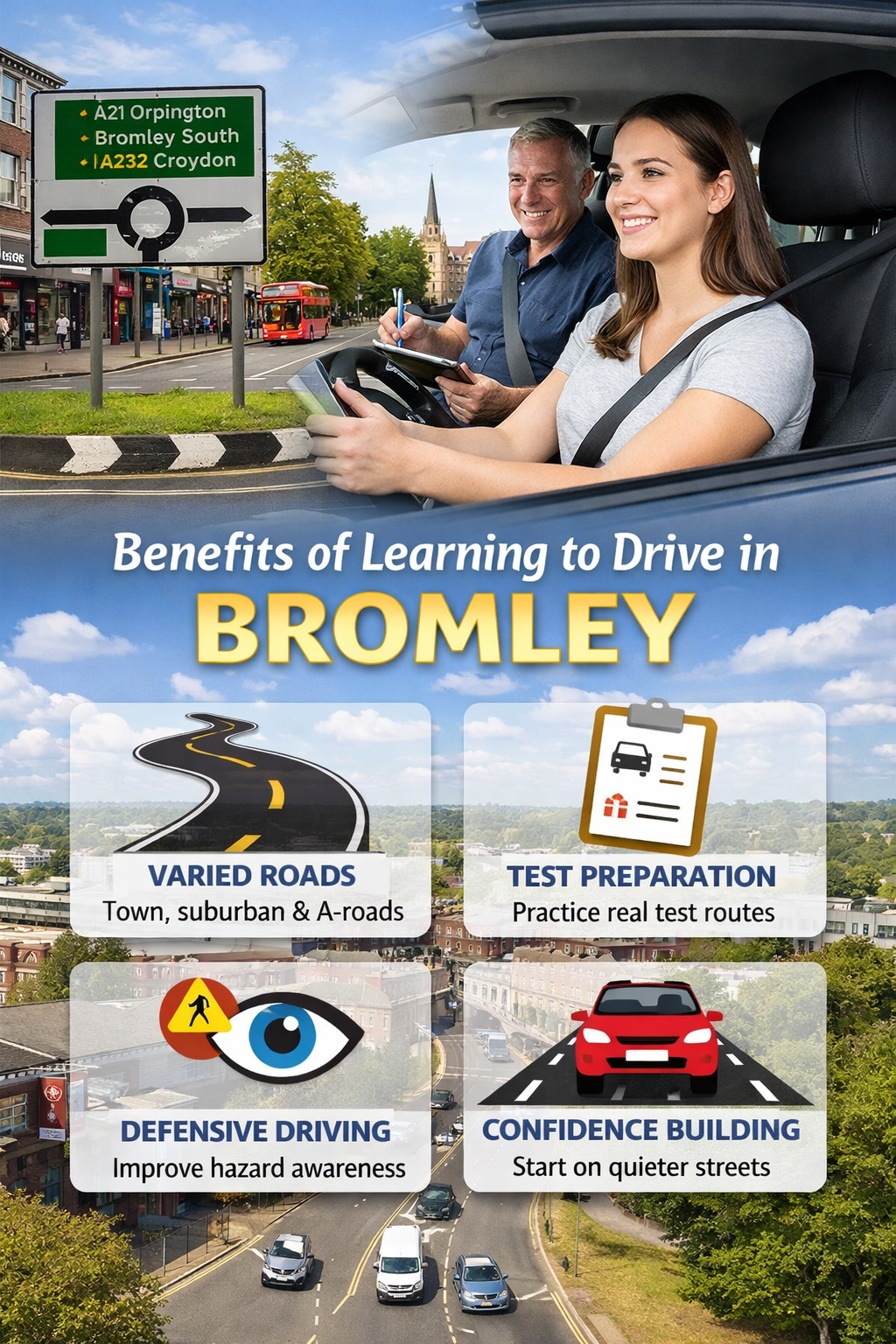
Bromley offers a diverse range of road environments, from busy urban streets to quieter suburban roads. Practical driver training ensures you are equipped to handle them all.
Urban Driving Exercises
The vibrant and often congested environment of Bromley’s urban areas presents unique challenges that require specific skills.
- Junctions: Negotiating intersections, understanding right of way, and anticipating the actions of other drivers. This is a dynamic environment where clear communication and precise manoeuvres are essential.
- Controlled Junctions: Those controlled by traffic lights or police officers.
- Uncontrolled Junctions: Where priority is determined by road markings or general traffic rules.
- Roundabouts: Understanding their signage, entry and exit procedures, and the flow of traffic.
- Traffic Lights: Responding correctly to red, amber, and green signals, and understanding the implications of pedestrian crossings.
- Bus Lanes and Cycle Lanes: Recognizing and adhering to their specific regulations.
- Parking in Urban Environments: Mastering parallel parking, bay parking, and angle parking on busy streets. This is a skill that requires spatial judgment and precise vehicle control.
Suburban Road Acclimatisation
Moving into quieter suburban areas still requires vigilance and awareness of different driving dynamics.
- Residential Streets: Driving at appropriate speeds, being aware of parked cars, pedestrians, and children. The presence of driveways necessitates vigilance for emerging vehicles.
- Speed Limits: Adhering to the designated speed limits, which are often lower in residential areas.
- Pedestrian Crossings: Ensuring clear visibility and stopping for pedestrians, even at unmarked crossings.
- Emerging from Driveways: The process of safely joining traffic from a private driveway.
Rural and Dual Carriageway Approaches
While Bromley may not be predominantly rural, understanding how to navigate these environments or approaching dual carriageways is part of comprehensive training.
- Dual Carriageways: Understanding lane discipline at higher speeds, safe overtaking procedures, and the specific rules governing these roads.
- Overtaking: Executing overtaking manoeuvres safely and efficiently on appropriate roads, ensuring sufficient visibility and clear space.
- Country Lanes: Navigating narrower roads with reduced visibility, often encountering slower-moving vehicles, cyclists, or farm machinery.
Safety on the Roads: Hazard Perception and Risk Management
A fundamental aspect of practical driver training is developing a keen sense of hazard perception and the ability to manage risks effectively. This moves beyond simply following rules to understanding the potential consequences of actions.
Identifying Potential Hazards
Hazard perception is the ability to spot potential dangers before they become immediate threats. It’s like having a sixth sense for trouble on the road.
- Observational Skills: Continuously scanning the road ahead, to the sides, and behind, noting changes in the environment and the behaviour of other road users.
- Predicting Actions: Anticipating what other drivers, cyclists, or pedestrians might do based on their behaviour, vehicle positioning, and road conditions.
- Recognising Road Surface Conditions: Identifying potential hazards such as potholes, loose gravel, wet patches, or icy surfaces.
- Understanding Vulnerable Road Users: Paying particular attention to pedestrians, cyclists, and motorcyclists, who are more exposed to danger.
Risk Assessment and Mitigation
Once a hazard is identified, the next step is to assess the level of risk and take appropriate action to mitigate it.
- Assessing Speed and Distance: Judging whether your speed is appropriate for the road conditions and the distance to potential hazards.
- Maintaining Safe Following Distance: Leaving adequate space between your vehicle and the one in front, providing time to react to sudden braking. This is often referred to as the “two-second rule” or “three-second rule.”
- Mirror, Signal, Manoeuvre: The mantra of safe driving, ensuring you are aware of your surroundings before initiating any change in direction or speed.
- Emergency Procedures: Knowing how to react in emergency situations, such as a tyre blowout or a sudden obstruction.
The Importance of ‘Defensive Driving’
The concept of defensive driving is a cornerstone of responsible motoring. It involves driving in a way that anticipates and prepares for the worst-case scenario, even if it originates from the actions of others.
- Anticipating Other Drivers’ Mistakes: Assuming other road users may not always adhere to rules or may make errors.
- Creating Space: Strategically positioning your vehicle to provide escape routes if a situation deteriorates.
- Visibility: Ensuring your vehicle is visible to others, especially in poor light conditions or adverse weather.
For those interested in enhancing their driving skills, a related article on intensive driving courses can provide valuable insights. Many learners in Bromley have found that these courses offer a fast and effective way to gain confidence behind the wheel. If you’re considering this option, you might want to check out the information available in this article, which outlines the benefits and structure of intensive training programs.
The Driving Test and Beyond
The practical driving test is the culmination of your training, but it represents the beginning of your independent driving journey. Continuous learning and development are key.
Preparing for the Practical Driving Test
The driving test is designed to assess your ability to drive safely and competently in a variety of road conditions. Instructors will guide you through mock tests to build confidence.
- Understanding the Test Requirements: Familiarizing yourself with the format of the test, including the independent driving section and any required manoeuvres.
- Mock Driving Tests: Simulating the actual test environment to identify areas for improvement and reduce pre-test anxiety.
- Familiarity with Test Routes: While routes vary, instructors will often cover common testing areas to ensure you are familiar with the types of roads and junctions you might encounter.
- Common Faults and How to Avoid Them: Instructors will highlight typical mistakes made by candidates and provide strategies to prevent them.
Post-Test Development and Continuous Learning
Passing your driving test is a significant achievement, but it is not the end of your learning process. The skills honed during training provide a solid foundation for continued development.
- Refresher Courses: Periodically undertaking refresher lessons to reinforce good driving habits and address any developing bad practices.
- Advanced Driving Courses: Exploring opportunities to enhance your driving skills further, such as participating in advanced driver training programs. These courses can teach techniques for even greater control and awareness.
- Adapting to Different Vehicles: If you progress to driving different types of vehicles, understanding their unique handling characteristics is important.
- Staying Updated on Road Laws: While major changes are infrequent, remaining aware of any new regulations or road safety initiatives is beneficial.
In conclusion, practical driver training across Bromley is a structured and comprehensive process designed to equip individuals with the knowledge and skills necessary to become safe, responsible, and confident road users. It is a journey that requires dedication, practice, and the guidance of experienced instructors who are committed to fostering a lifelong positive relationship with driving.