The Importance of a Qualified Instructor In Bromley
Acquiring a driver’s license is a significant milestone, opening doors to independence and convenience. The journey to this achievement, however, hinges critically on the instruction received. A competent driving instructor serves not merely as a teacher of mechanics, but as a guide, a mentor, and a builder of confidence. Their role extends beyond navigating traffic; it involves instilling safe driving habits, understanding road rules, and developing the critical judgment necessary to respond to unpredictable situations. In Bromley, as in any urban and suburban environment, the density of traffic and variety of road conditions underscore the need for instruction that is both thorough and tailored. Selecting the right instructor is akin to choosing a skilled artisan to craft a vital tool; the quality of their work directly impacts the user’s ability and safety.
Understanding the Role of a Driving Instructor
A driving instructor is professionally trained and licensed by the DVSA (Driver and Vehicle Standards Agency) in the UK. This qualification signifies a commitment to a standardized level of teaching and a deep understanding of the nuances of safe driving. Beyond technical proficiency, effective instructors possess pedagogical skills. They are adept at breaking down complex maneuvers into manageable steps, identifying individual learning styles, and providing constructive feedback. A good instructor will observe a student’s performance, not just for errors, but for the underlying thought processes, offering guidance that addresses root causes rather than simply correcting mistakes. This patient and methodical approach is crucial for building a solid foundation for lifelong safe driving. The DVSA’s role in setting standards ensures a baseline of quality, but the best instructors go beyond the minimum requirements, incorporating a learner-centric philosophy into their teaching.
Factors to Consider When Choosing an Instructor
The process of selecting a driving instructor in Bromley involves careful consideration of several key factors. Price is often a primary concern, but it should not be the sole determinant. The adage “you get what you pay for” frequently holds true in this context. An instructor who offers significantly lower rates may be a newly qualified instructor seeking experience, or they might be cutting corners on essential aspects of training, such as the thoroughness of lesson coverage or the provision of detailed feedback. Conversely, premium pricing does not automatically guarantee superior instruction; it is essential to investigate beyond the cost. Location is another practical consideration. While instructors may travel to a student’s home, frequent lessons without excessive travel time can be more efficient, allowing for more actual driving practice within the allocated lesson duration. Reviews and testimonials from previous students are invaluable resources. Online platforms and local community groups often feature feedback on instructors, providing insights into their teaching style, patience, and effectiveness.
Investigating Instructor Qualifications and Experience
The DVSA licensing system is a fundamental starting point. Instructors must display a valid license, often a pink or green certificate, indicating their qualified status. Experienced instructors often have a track record of success, with a higher first-time pass rate for their students. This is not solely an indicator of their teaching ability but also of their skill in preparing students for the specific demands of the driving test. Inquiries about their experience with different learning styles, their approach to nervous drivers, and their specialization (e.g., automatic or manual transmission) can reveal whether their expertise aligns with a student’s needs. Some instructors may have advanced qualifications, such as being IAM (Institute of Advanced Motorists) or RoSPA (Royal Society for the Prevention of Accidents) qualified, which indicates a commitment to developing advanced driving skills beyond the basic test requirements. This can be beneficial for learners who wish to develop a higher level of competence.
Understanding Different Teaching Styles
Driving instructors, like teachers in any field, possess distinct teaching styles. Some may adopt a more direct, authoritative approach, emphasizing rules and precision. Others lean towards a more collaborative style, encouraging students to explore and problem-solve under their guidance. Understanding your own learning preferences is crucial. If you thrive on clear, step-by-step instructions, a direct approach might be suitable. If you prefer to figure things out with supportive prompts, a more collaborative style could be a better fit. Many instructors will offer an initial assessment lesson, allowing you to experience their teaching style firsthand without commitment. This trial period is an excellent opportunity to gauge compatibility and to ask detailed questions about their methodology. It is about finding a rhythm that resonates with your learning pace and ensuring a comfortable and productive learning environment.
Assessing Instructor Reliability and Professionalism
Beyond the core teaching skills, the operational aspects of an instructor’s service are paramount. Reliability means showing up for lessons on time and adhering to the agreed schedule. A consistent pattern of lateness or cancellations can be incredibly disruptive to a student’s progress, creating frustration and potentially leading to missed test opportunities. Professionalism encompasses not only punctuality but also clear communication, ethical conduct, and a well-maintained vehicle. A professional instructor will have a clear pricing structure, transparent terms and conditions, and will maintain a professional demeanor throughout each lesson. The driving school’s reputation, if applicable, can also offer insights into the professionalism of its instructors.
The Importance of a Well-Maintained Vehicle
The vehicle used for instruction is more than just a mode of transport for lessons; it is an integral part of the learning environment. A well-maintained car is safer, more reliable, and often equipped with dual controls, which are essential for instructor intervention in emergency situations. A clean and orderly interior can contribute to a more focused and pleasant learning experience. Learners should feel comfortable asking about the vehicle’s condition and the instructor’s maintenance schedule. It reflects a commitment to safety and a consideration for the student’s well-being. A vehicle that is in poor repair or constantly experiencing mechanical issues can become a significant impediment to progress and a source of anxiety for the learner.
Effective Communication and Feedback
Clear and consistent communication is the bedrock of a successful learning relationship. An instructor should be able to explain concepts clearly, provide precise instructions, and offer timely and constructive feedback. This feedback should not be limited to identifying errors; it should also highlight strengths and areas of improvement, explaining why certain actions are correct or incorrect. Active listening is also a key component. A good instructor will pay attention to a student’s questions and concerns, addressing them thoroughly and empathetically. The ability of an instructor to adapt their communication style to suit the learner’s understanding is a mark of an experienced and effective educator.
If you’re looking for the best driving instructors in Bromley, you might also find it helpful to read about the new Bromley driving test centre. This article provides valuable insights into the facilities and services available, which can greatly enhance your driving experience. To learn more, check out the article here: New Bromley Driving Test Centre.
Finding Top Driving Instructors in Bromley
The Local Landscape of Driving Schools
Bromley, a vibrant borough in South East London, features a diverse range of driving schools and independent instructors. Navigating this landscape requires a strategic approach to identify those who consistently deliver high-quality instruction. The local presence of well-established driving schools can provide a degree of assurance, as they often have rigorous selection processes for their instructors and a vested interest in maintaining a good reputation. However, it is also important to consider independent instructors, some of whom may offer a more personalized and flexible service. The key is to look beyond the sheer number of options and focus on the quality of instruction offered, irrespective of whether they are part of a larger organization or operate independently.
Researching Local Driving Schools and Instructors
An initial step in the research process involves perusing online directories and review websites. Platforms like Google Reviews, Trustpilot, and specialized driving school directories can offer a wealth of information. Look for patterns in reviews, paying attention to recurring themes regarding teaching style, pass rates, and overall student satisfaction. Do not discount positive reviews that are specific and detailed; these often provide more valuable insights than generic praise. Conversely, negative reviews should be scrutinized for constructive criticism. A single negative review might be an anomaly, but a consistent pattern of complaints from different students about the same issue warrants careful consideration.
The Impact of Professional Body Memberships
Membership in professional bodies such as the Driving Instructors Association (DIA) or the Motor Schools Association (MSA) can indicate an instructor’s commitment to professionalism and ongoing development. These organizations often have codes of conduct that members are expected to adhere to, promoting ethical practices and high standards of instruction. While not a definitive guarantee of quality, it suggests a level of dedication to the profession that goes beyond the minimum DVSA requirements. These affiliations can also offer access to further training and resources, enabling instructors to stay abreast of the latest teaching methodologies and road safety practices.
Understanding Pass Rates and Their Significance
A driving instructor’s pass rate is often presented as a key metric of success. While a high pass rate is undoubtedly desirable, it should be interpreted with nuance. A genuinely high pass rate suggests that an instructor is adept at preparing students for the test and that their students are well-equipped to handle the demands of the examination. However, it is crucial to understand how pass rates are calculated. Are they based on first-time passes, or do they include students who have taken multiple attempts? Some instructors may focus heavily on test-route familiarization, which can artificially inflate pass rates but may not equip students with the broader skills needed for general driving.
Examining a True Representation of Success
The most reliable assessment of an instructor’s effectiveness lies in their ability to foster genuine understanding and confident independent driving, not just the ability to pass a specific test. A skilled instructor aims to produce safe, responsible drivers who can navigate various road conditions with competence and foresight. Therefore, in addition to pass rates, consider feedback that highlights how well-prepared students feel for everyday driving, their confidence levels, and their ability to make informed decisions on the road. An instructor who prioritizes a comprehensive understanding of driving principles over mere test performance is likely to produce more capable and safer drivers in the long run.
The Pitfalls of Anecdotal Evidence
While personal recommendations are valuable, relying solely on anecdotal evidence without further investigation can be misleading. A friend or family member’s positive experience with a particular instructor may be due to a coincidental alignment of their learning style with the instructor’s methods, or it might have occurred under different circumstances. It is essential to conduct your own research and gather information from multiple sources to form a balanced perspective. The goal is to find an instructor who is a good fit for your specific learning needs and personality, not just for someone else.
Key Skills and Qualities of Top Driving Instructors
Patience and Empathy as Cornerstones of Instruction
The process of learning to drive can be a journey fraught with nerves and self-doubt. A top driving instructor understands this and cultivates an environment of patience and empathy. They recognize that each learner progresses at their own pace and that mistakes are a natural part of the learning curve. Instead of becoming frustrated, they offer calm guidance and encouragement. This supportive atmosphere is crucial for building confidence, which is as vital to successful driving as technical skill. An instructor who can de-escalate a student’s anxiety and replace it with a sense of calm competence is invaluable.
The Art of Positive Reinforcement
Effective instructors utilize positive reinforcement to build confidence. They acknowledge and praise correct actions and good decision-making, reinforcing desired behaviors. This is not about unwarranted flattery, but about recognizing and validating progress. When a student masters a difficult maneuver or handles a complex traffic situation well, acknowledging this success strengthens their belief in their own abilities. This creates a positive feedback loop, encouraging greater effort and reducing the fear of failure.
Managing Learner Anxiety and Nerves
Driving can be a daunting prospect, particularly for those with existing anxieties. A skilled instructor possesses the tools to manage learner nerves effectively. This might involve starting in quiet, low-traffic areas and gradually introducing more challenging environments. They will also explain maneuvers thoroughly, demystifying the process and reducing uncertainty. An instructor who can communicate a sense of control and predictability, while also preparing the student for the inherent unpredictability of the road, is a significant asset. Techniques such as deep breathing exercises or a calm, reassuring tone of voice can also play a role in settling a nervous driver.
Adapting to Individual Learning Styles
No two learners are identical. Some absorb information visually, others through auditory explanations, and still others through kinesthetic experience – learning by doing. Top instructors are adept at identifying a student’s preferred learning style and tailoring their teaching accordingly. This might involve using diagrams, verbal explanations, or practical demonstrations. The ability to switch between different teaching methods ensures that the information is conveyed effectively and retained by the student. A one-size-fits-all approach is rarely successful in driving instruction.
Visual Aids and Demonstrations
For visual learners, instructors may use diagrams, mirror work to illustrate blind spots, or even pre-recorded videos to explain complex concepts. Demonstrations of manoeuvres, executed with precision by the instructor, provide a clear visual template for the student to follow. These visual cues can help solidify understanding and provide a benchmark for the student’s own practice.
Verbal Explanations and Questioning
Auditory learners benefit from clear, concise verbal explanations. An instructor can use analogies or step-by-step narratives to guide the student through a process. Furthermore, good instructors encourage questions and actively engage students in dialogue, prompting them to think critically about their actions and the road environment. This active questioning can deepen understanding and encourage problem-solving.
Practical Application and Repetition
Kinesthetic learners thrive on hands-on experience. This involves plenty of supervised practice, allowing them to physically perform maneuvers and develop muscle memory. Repetition, under the instructor’s watchful eye, helps to refine techniques and build confidence. The instructor provides immediate feedback, guiding the student to make necessary adjustments and encouraging them to practice until the action becomes more intuitive.
Fostering a Proactive and Defensive Driving Mindset
Beyond passing the test, the ultimate goal is to cultivate a safe and responsible driver. Top instructors instill a proactive and defensive driving mindset. This involves teaching students to anticipate potential hazards, understand the actions of other road users, and always maintain a safe distance. It is about looking beyond the immediate task of steering and accelerating, and instead, actively scanning the environment for potential risks. This foresight is the hallmark of a seasoned driver.
Hazard Perception and Risk Assessment
Hazard perception is the ability to identify potential dangers before they become immediate threats. This skill is honed through extensive practice and instruction focused on observation. Instructors will guide students to look for subtle cues – a pedestrian near the kerb, a car with its brake lights illuminated further ahead, or unusual traffic patterns – and to consider the potential consequences. Risk assessment involves evaluating the severity of a hazard and deciding on the appropriate course of action, such as adjusting speed, changing lane, or preparing to stop.
Understanding Other Road Users
Roads are shared spaces, and understanding the intentions and limitations of other users is crucial. This includes drivers of cars, motorcyclists, cyclists, and pedestrians. Instructors will teach students to observe their behaviour, anticipate their actions, and to communicate their own intentions clearly through signaling and appropriate road positioning. This mutual understanding promotes smoother traffic flow and reduces the likelihood of conflict or accidents.
Choosing the Right Transmission: Manual vs. Automatic

The Nuances of Manual Transmission Driving
Learning to drive a manual transmission vehicle involves mastering a more complex set of skills. The clutch pedal, gear stick, and accelerator must be coordinated precisely, requiring significant practice to develop fluency. While it offers greater control over the vehicle’s power and can be more fuel-efficient, it also demands more cognitive load from the driver, especially in challenging traffic conditions. Instructors experienced in manual instruction will guide students through the intricacies of gear changes, hill starts, and clutch control, ensuring a solid foundation.
Developing Clutch Control and Gear Changes
The initial focus in manual driving instruction is typically on developing smooth clutch control and accurate gear changes. This often involves starting in a quiet car park to practice engaging the clutch without stalling. The instructor will explain the biting point and the gradual release of the clutch pedal. Gear changes are taught in sequence, emphasizing the correct RPM range for each gear to maintain optimal engine performance and fuel efficiency. Mastering these skills allows for confident progression through the gears in various driving situations.
Hill starts and navigating stop-start traffic are common challenges for learners of manual transmission. Instructors will teach techniques to prevent rolling backwards on inclines, often involving a combination of the handbrake and clutch. In heavy traffic, they will emphasize maintaining a safe gap and executing smooth gear changes to avoid jerky movements, which can be both uncomfortable for passengers and inefficient for the vehicle. Consistent practice under the guidance of an experienced instructor is key to overcoming these hurdles.
The Convenience of Automatic Transmission Driving
Automatic transmission vehicles have become increasingly popular due to their ease of use. With no clutch pedal and automatic gear selection, the driver can focus more on steering, observation, and road awareness. This makes them an attractive option for learners who may be intimidated by the complexities of manual driving or who anticipate primarily driving in urban environments with frequent traffic congestion. Instructors specializing in automatic tuition will adapt their lessons to focus on the core principles of safe driving without the added layer of clutch and gear management.
Simplified Learning Curve and Reduced Stress
The simplified operation of an automatic vehicle typically leads to a shorter learning curve and reduced stress for new drivers. The absence of clutch control means that stalling is not an issue, and gear changes are handled by the vehicle itself. This allows learners to concentrate on developing their observation skills, road positioning, and hazard perception from the outset. For individuals who find mechanical processes challenging or have limited time for instruction, an automatic license can be a more accessible route to obtaining their driving privileges.
Suitability for Urban Driving
Automatic vehicles are particularly well-suited for urban driving environments characterized by frequent stops, starts, and traffic lights. The ease of operation in these conditions minimizes driver fatigue and allows for smoother progress through congested areas. While manual transmission offers greater engagement and potentially better fuel economy on open roads, the convenience and reduced mental load of an automatic are often preferred for city driving. Instructors will still cover essential skills such as effective braking, anticipation, and lane discipline, even though the mechanical aspects of driving are simplified.
Making the Right Choice for You
The decision between learning manual or automatic transmission is a personal one, influenced by your individual circumstances and learning preferences. Consider the type of driving you anticipate doing most frequently. If you expect to spend a significant amount of time in city traffic, an automatic may be the more practical choice. If you enjoy the engagement of driving and the potential for greater fuel efficiency on longer journeys, a manual might be preferable. It is also worth considering the availability of instructors in your area who specialize in each transmission type.
Considering Your Future Driving Needs
Thoroughly assess your long-term driving aspirations. If you envision yourself driving a variety of vehicles, including older models or those in different countries where manual transmission may be more common, obtaining a manual license might offer greater versatility. However, if your plans are focused on personal transport within a modern context, an automatic license will likely suffice. Instructors can offer valuable insights based on their experience with various learners and their driving objectives.
If you’re considering taking driving lessons in Bromley, you might find it helpful to explore the factors that contribute to the stress of learning to drive. Understanding these challenges can enhance your experience and make you more prepared for your lessons. For more insights on this topic, check out this informative article on why learning to drive can be so stressful. You can read it here.
Preparing for Your Driving Test in Bromley
Understanding the DVSA Test Requirements
The Driving and Vehicle Standards Agency (DVSA) sets the standard for driving tests across the UK. Bromley driving instructors are well-versed in these requirements, which are designed to ensure that all newly licensed drivers are competent and safe. The test comprises three main components: an eyesight check, a “show me, tell me” vehicle safety question, and the practical on-road driving assessment. The practical assessment evaluates your ability to drive safely and independently in various road conditions, demonstrating your knowledge of the Highway Code and your ability to apply it.
The Eyesight Test
As a mandatory part of the test, you will be asked to read a number plate from a specific distance. This ensures that you have the minimum required vision to drive safely. If you wear glasses or contact lenses, you must wear them during the test. Failure to meet the eyesight requirement will result in immediate disqualification from the test.
The “Show Me, Tell Me” Questions
These questions are designed to assess your understanding of vehicle safety and operation. The “tell me” question is asked at the start of the test, and you will be asked to explain how you would carry out a safety check. The “show me” question is asked while you are driving, and you will be asked to demonstrate how to perform a specific safety check (e.g., showing how to switch on the rear fog light). Familiarity with these questions, which are published by the DVSA, is essential.
Mastering Essential Driving Manoeuvres
The practical driving test includes the execution of at least one “bay” parking manoeuvre, an emergency stop, and potentially a pulled-up manoeuvre (either on the right-hand side of the road, reversing for two car lengths, and rejoining traffic, or pulling up on a street and reversing into a parking bay). Instructors will dedicate significant lesson time to mastering these. Precision, observation, and control are paramount during these exercises. Your instructor will guide you through the correct procedure, emphasizing the importance of checking your surroundings before, during, and after each manoeuvre.
Bay Parking Techniques
There are various methods for bay parking, including forward bay parking and reversing bay parking. Your instructor will teach you the appropriate techniques, which involve precise steering, clutch control, and constant observation of your surroundings, including mirrors and by looking over your shoulder. They will highlight the importance of maintaining a consistent distance from other vehicles and the lines of the bays to avoid faults.
The Emergency Stop
The emergency stop requires you to bring the vehicle to a sudden, safe stop when instructed by the examiner. This tests your ability to react quickly and decisively to a simulated hazard. Your instructor will practice this with you under varying conditions, emphasizing the importance of maintaining control of the vehicle and carrying out the correct procedure, including checking your mirrors and applying the brakes firmly and steadily.
Pulling Up on the Right and Reversing
This manoeuvre involves pulling up on the right-hand side of the road, reversing for approximately two car lengths, and then safely rejoining traffic. It requires good spatial awareness, clutch control, and effective use of mirrors and direct vision. Your instructor will guide you on how to position the vehicle correctly before stopping, how to reverse in a controlled manner, and how to check for oncoming traffic before moving off.
Practicing Test Routes and Conditions
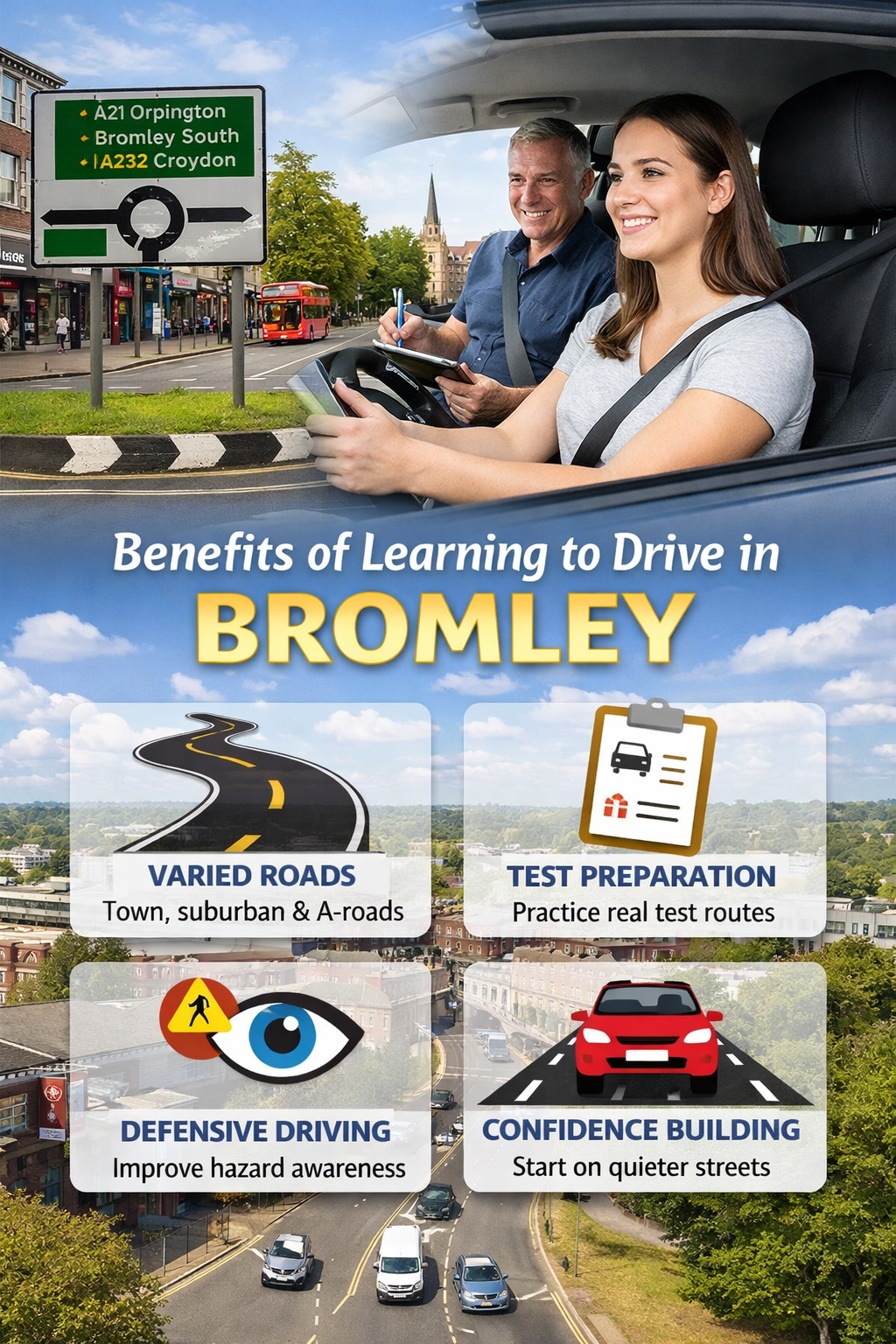
Familiarity with the local roads and potential test routes in Bromley is a significant advantage. Experienced instructors will often incorporate these routes into their lessons, allowing students to become comfortable with the junctions, traffic lights, and road layouts that are likely to be encountered during the test. Beyond route familiarity, instructors will also simulate test conditions, encouraging independent driving and decision-making. This includes practicing in various weather conditions, at different times of the day, and in varying traffic densities, preparing you for the unpredictable nature of real-world driving.
The Value of Mock Tests
Conducting mock driving tests is a crucial part of the preparation process. These simulated tests, conducted by your instructor under exam conditions, allow you to experience the pressure of assessment in a controlled environment. They provide an opportunity to identify any remaining weaknesses, refine your technique, and build confidence before the actual test. Following a mock test, your instructor will provide detailed feedback, highlighting areas that require further attention, and help you develop strategies for improvement.
Developing Independent Driving Skills
The modern driving test places a strong emphasis on independent driving. You will be expected to navigate for a period of approximately 20 minutes, either following traffic signs or directions from a sat-nav provided by the examiner. Your instructor will help you develop the skills necessary for this component, including effective route planning, anticipation of upcoming junctions, and the ability to make your own safe decisions without constant instructions. This fosters a sense of autonomy and preparedness for real-world driving.
Post-Test Driving and Continuing Professional Development
Maintaining and Enhancing Driving Skills
Passing the driving test is not the end of your driver education, but rather the beginning of a lifelong commitment to safe driving. The skills learned during instruction, while thorough, will inevitably evolve as you gain more experience on the road. Many instructors offer post-test training or refresher courses, designed to help new drivers transition into more experienced road users. These can cover a range of topics, from advanced maneuvering techniques to navigating challenging road conditions and developing advanced hazard perception.
Refresher Courses and Advanced Training
A refresher course can be particularly beneficial for drivers who have recently passed or who have had a period away from driving. These sessions allow you to revisit fundamental principles, address any developing bad habits, and build confidence in specific areas. For those seeking to elevate their driving proficiency beyond the basic test requirements, advanced training programs, such as those offered by IAM or RoSPA, provide a structured pathway to becoming a highly skilled and safe driver. These courses often focus on developing a smoother, more efficient driving style, and a deeper understanding of vehicle dynamics and roadcraft.
Understanding Vehicle Technology and Road Rules
Modern vehicles are equipped with increasingly sophisticated technology, such as advanced driver-assistance systems (ADAS). Understanding how these systems work, their limitations, and how to use them effectively is becoming an integral part of safe driving. Furthermore, road rules and regulations can evolve. Staying informed about any changes to the Highway Code or local traffic management schemes ensures you are always driving in compliance with current legislation and contributing to a safer road network. Your driving instructor may be able to provide guidance on these evolving aspects of driving.
Insurance and the New Driver’s Journey
The practicalities of car insurance are a significant consideration for new drivers. Insurers often view newly qualified drivers as higher risk due to their limited practical experience. This can result in higher premiums. However, there are strategies to mitigate these costs. Insurers may offer policies that monitor driving behavior through telematics devices, rewarding safe driving with lower premiums. Building a clean driving record, free from accidents and driving convictions, is paramount in demonstrating your reliability as a driver to insurance providers over time.
Telematics and Black Box Insurance
Telematics insurance, often referred to as “black box” insurance, involves fitting a small device or using a mobile app to monitor your driving habits. This data can include speed, acceleration, braking, and the times and locations you drive. Insurers use this information to assess your individual risk profile. Safe driving can lead to more affordable premiums, while risky behaviour can result in increased costs or even policy cancellation. This type of insurance encourages responsible driving from the outset.
Building a Clean Driving Record
The most effective way to reduce insurance costs and demonstrate your suitability as a driver is to maintain a clean driving record. This means avoiding any traffic violations, speeding tickets, or accidents. Practicing defensive driving techniques, always adhering to speed limits and road signs, and driving with a heightened awareness of your surroundings will contribute to a safer driving history. Over time, as you build experience and a reputation for safe driving, your insurance premiums are likely to decrease, making car ownership more affordable.
The Long-Term Benefits of Professional Instruction
Investing in quality driving instruction from a reputable instructor in Bromley offers benefits that extend far beyond the initial acquisition of a driving license. It provides a foundation for lifelong safe driving, reducing the risk of accidents and the associated personal and financial consequences. The confidence and independence gained through competent instruction empower individuals to navigate their world with greater ease and security. A skilled instructor is not just teaching you to pass a test; they are equipping you with a vital life skill, fostering a sense of responsibility, and contributing to safer roads for everyone. The knowledge and habits instilled by a good instructor act as a compass, guiding you through the complexities of the road for years to come.