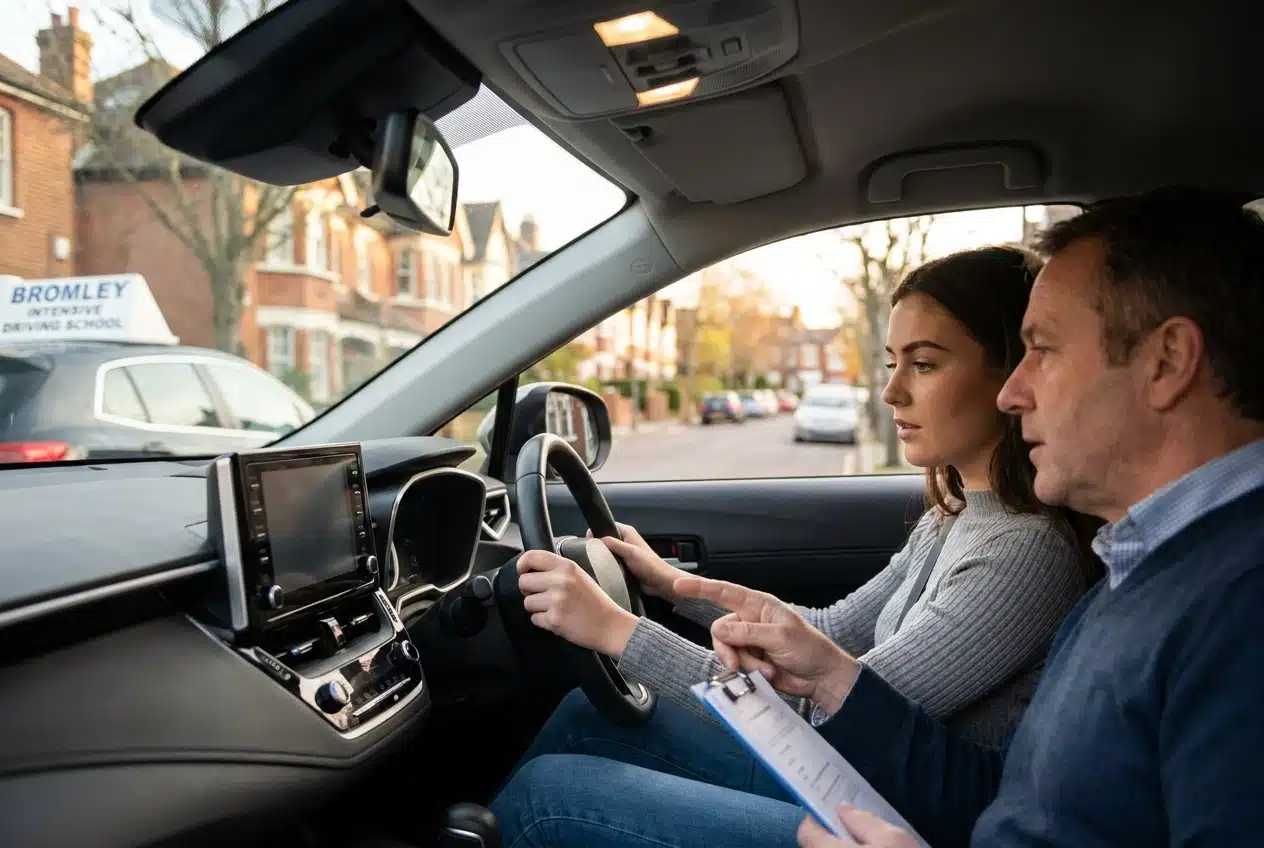
Choosing the right test centre can make a real difference to your chances of passing first time. If you are preparing for your driving test in South East London, you have likely come across plenty of bromley driving test centre reviews online, but knowing which information to trust is not always straightforward. This guide cuts through the noise and gives you a clear, honest picture of what to expect.
We have analysed pass rate data, spoken to recent test candidates, and broken down the most common routes examiners use in the area. Whether you are wondering how Bromley compares to neighbouring test centres, what the local roads are actually like, or how to prepare for the specific challenges this centre presents, you will find practical answers here.
This is not a generic overview. It is a detailed analysis designed specifically for learner drivers who want to walk into their test feeling genuinely prepared. By the time you finish reading, you will have a thorough understanding of Bromley Driving Test Centre and a clear plan for giving yourself the best possible chance of success.
Test Centre Basics: Location, Parking and Arrival Tips
Bromley (London) Driving Test Centre is located at 121-123 Burnt Ash Lane, Bromley, BR1 5AB, operated by the Driver and Vehicle Standards Agency (DVSA) and confirmed active as of July 2026. The centre sits conveniently between the A20 and the South Circular, making it accessible from multiple directions across south-east London. Before booking your test here, it is worth understanding exactly what the centre offers. Only car practical tests are conducted at this site; if you are hoping to take a motorcycle or LGV test, you will need to look elsewhere, as neither category is available at this location.
Getting In: The Brindley Way Rule
One of the most practical pieces of advice any first-time visitor needs is how to enter the car park correctly. You must access the car park from Brindley Way, not through the narrow passage between the shops that sits alongside the building. That passage is not suitable for vehicles, and attempting to use it is a common mistake among candidates who are unfamiliar with the site. Using Brindley Way as your entry point is straightforward once you know to look for it, and arriving knowing this detail removes one potential source of pre-test confusion. For full route guidance and local context, the Bromley Driving Test Centre information page provides a helpful overview of access arrangements.
Parking, Arrival and What to Bring
Parking at the centre is limited, and spaces can fill up quickly, particularly during busier morning slots. Arriving in your instructor’s dual-controlled car is strongly recommended, as it removes the pressure of finding a space independently and allows you to use the final minutes before your test to settle your nerves constructively. Public transport is a perfectly viable alternative; buses on Burnt Ash Lane stop within a short walk of the centre. For detailed insider tips on navigating the test centre and surrounding roads, third-party route resources can also support your preparation.
Finally, and critically, you must bring your valid provisional driving licence to the test. There are no exceptions to this rule. If you arrive without it, the examiner cannot proceed with the test, and your test fee will be forfeited entirely. Double-check your licence the evening before, and keep it somewhere you will not forget on the morning of your appointment.
What Happens on Test Day at Bromley
Understanding exactly what to expect on test day removes much of the anxiety that holds learner drivers back. The practical driving test at Bromley follows a clear, structured format set by the DVSA, and knowing each stage in advance puts you in a far stronger position to perform at your best.
The Eyesight Check
Every test at Bromley begins before you even touch the steering wheel. The examiner will ask you to read a standard number plate from a distance of 20 metres. This is a straightforward task if your vision is adequate, but it carries serious consequences if you cannot complete it successfully. Failing the eyesight check ends the test immediately, with no opportunity to continue. If you wear glasses or contact lenses, make absolutely certain you bring them and that your prescription is current. This is not a step to overlook.
Show Me, Tell Me Vehicle Safety Questions
Once the eyesight check is passed, the examiner will ask one “tell me” vehicle safety question before you begin driving. This might involve explaining how you would check tyre pressure or whether your brake lights are functioning correctly. A second “show me” question is asked while you are already driving, asking you to demonstrate something practical such as activating the rear heated screen or adjusting the headlights. Together, these two questions form a scored element of the test, so preparing for the full DVSA question bank beforehand is strongly recommended.
The Practical Drive
The main driving portion lasts approximately 35 to 40 minutes and takes you through a varied mix of road types in and around Bromley. You can expect residential streets, roundabouts, multi-lane junctions, and sections of the A21. The examiner assesses your observation, hazard response, vehicle control, and decision-making continuously throughout this phase.
For 20 to 35 minutes of the test, you will drive independently, either following a sat-nav device provided by the examiner or responding to road signs, with no turn-by-turn guidance. A wrong turn during this section is not automatically recorded as a fault, provided you respond calmly and continue driving safely. The examiner will help redirect you back to the route if needed.
Reversing Manoeuvre and Emergency Stop
You will complete one reversing manoeuvre selected from the standard DVSA set, which may include a forward bay park, reverse bay park, parallel park, or pulling up on the right-hand side of the road. An emergency stop may also be requested at the examiner’s discretion, though it is not included in every test. Practising all manoeuvres thoroughly ensures you are prepared regardless of which one is selected.
Bromley Pass Rate Analysis: What the 2024/25 Data Really Tells You
In 2024/25, Bromley Driving Test Centre processed 10,868 tests, producing 5,614 passes and an overall pass rate of 51.73%. That equates to roughly 906 tests every month, making Bromley one of the busier test centres in south-east London. For any learner driver preparing here, that volume matters because it means examiners are experienced, consistent, and working to a well-established standard.
How Bromley Compares to the National Picture
The national average pass rate for 2024/25 sits at 51.8%, meaning Bromley’s result sits just 0.1 percentage points below that figure. In practical terms, this difference is statistically negligible. It tells you something important: Bromley is neither a particularly forgiving centre nor an unusually demanding one. It sits precisely where the national standard says it should. Across the UK, pass rates vary dramatically by test centre, ranging from as low as 33% at the most challenging urban centres to as high as 80% at remote rural locations. The highest-performing centres are almost exclusively in sparsely populated areas with minimal traffic complexity. Bromley, as a busy suburban London centre, achieving a rate close to 52% represents genuinely solid mid-range performance for its environment. Learners who read headlines about centres with 70% or 80% pass rates should understand those figures reflect quiet country roads, not transferable conditions.
Understanding Bromley’s Recent History
Pass rate data does not exist in isolation, and the historical trajectory at Bromley adds important context. The centre recorded a post-pandemic low of 40.6% in 2019/20, a period when tests were heavily disrupted and the pool of candidates included many who had waited months with limited practice time. As the backlog cleared and learner preparation normalised, the rate climbed steadily: 50.5% in 2021/22, peaking at 53.8% in 2022/23, then settling at 51.3% in 2023/24 and 51.73% in 2024/25. This stabilisation around the 51 to 52% range is consistent with what official DVSA test data shows nationally: post-pandemic recovery has plateaued and the industry has returned to a steady baseline. For learners, this trend confirms that the current pass rate reflects genuine, stable conditions rather than a temporary anomaly in either direction.
What the First-Attempt Data Really Means
Perhaps the most telling statistic is the first-attempt pass rate at Bromley, which stands at exactly 51.8%, matching the national average to one decimal place. This figure cuts through a common misconception: that some test centres are easier or harder than others in ways that affect your chances before you even start. The data does not support that view. What it does reinforce is that preparation quality is the single greatest factor in determining your result. Candidates who arrive at Bromley having completed structured lessons, covered the local road network thoroughly, and practised manoeuvres consistently are working with the same statistical baseline as learners anywhere in the country. The centre does not add difficulty; insufficient preparation does.
Who Passes Most Often? Age, Gender and Transmission Breakdowns
Breaking down the 2024/25 data by age, gender and transmission type reveals patterns that go far beyond the headline pass rate. For beginner drivers in Bromley, understanding which candidate groups perform best and why is one of the most practical steps you can take before booking your test.
Age: Why Starting Young Pays Off
The age breakdown at Bromley tells a compelling story. Seventeen-year-olds record the highest pass rate of any age group at an impressive 65.7%, while 24-year-olds see a notable dip to just 48.7%, the lowest figure among young adult candidates. By age 25, the rate recovers somewhat to 53.8%, suggesting the mid-20s dip is a genuine pattern rather than a statistical blip.
Why does this happen? Younger learners who begin driving lessons close to their 17th birthday and sit the test promptly benefit from faster skill acquisition, more consistent lesson frequency, and fewer competing life pressures. Candidates in their mid-20s, by contrast, often have work commitments, longer gaps between lessons, and higher levels of test anxiety built up over time. The data does not mean that older learners cannot succeed; it means they typically need more structured preparation and a clear, disciplined study plan to compensate for those extra pressures. If you are a late starter or an adult returner, this is not a ceiling on your potential. It is a signal to invest more deliberately in your preparation.
Gender: A Gap Worth Addressing
The gender split at Bromley mirrors a nationally documented pattern. Male candidates pass at 55.2%, while female candidates pass at 48.0%, a gap of 7.2 percentage points. Research by the Transport Research Laboratory into equality in the driving test has examined whether this gap reflects differences in preparation quality, supervised practice hours, or other factors. The consistent finding across national data is that the gap is largely addressable through targeted preparation rather than being an inherent outcome.
For female learners in Bromley, this data point should be read as a prompt to action rather than a discouragement. Working with an instructor who actively builds confidence alongside technical skill, practising the specific roads used on Bromley test routes, and completing structured mock tests under realistic conditions can all close that gap significantly. The 7.2 percentage point difference is real, but it is also a ceiling that motivated candidates regularly break through.
Automatic Transmission: A Growing Popularity, A Hidden Challenge
With automatic driving lessons increasingly popular across Bromley and south-east London, the automatic transmission pass rate deserves close attention. At 49.1%, Bromley’s automatic pass rate sits 2.7 percentage points below the national average of 51.8%, a meaningful gap that is easy to overlook when choosing how to learn. Analysis of over 500,000 tests by Cuvva’s January 2025 driving test study confirms that local route complexity significantly affects outcomes regardless of transmission type, and Bromley’s mix of A-roads, busy junctions and residential streets creates specific challenges.
For candidates learning in an automatic, this statistic underlines the importance of choosing an instructor with deep familiarity with Bromley’s actual test routes. EL’s Driving School’s specialist automatic tuition, built around the roads candidates will genuinely encounter on test day, directly targets this gap. Knowing Burnt Ash Lane, the Bromley town centre approaches and the dual-carriageway sections in advance removes the element of surprise that catches many automatic candidates off guard.
The Perfect Test: 159 Candidates Achieved Zero Faults
Perhaps the most motivating data point in the entire 2024/25 dataset is this: 159 candidates at Bromley completed their test with absolutely zero driving faults. No minors, no majors, a completely clean result. That figure confirms that perfection is not a theoretical ideal; it is a realistic and repeatable outcome for well-prepared candidates. Consistent practice, honest feedback from a qualified instructor, and thorough familiarity with the test environment are what separate those 159 candidates from the rest. That standard is available to any learner willing to prepare with the same level of commitment.
The Bromley Test Routes: Key Roads and What Examiners Are Looking For
The DVSA does not publish official test routes, and that silence is deliberate. The test is designed to assess real driving ability in live conditions, not the performance of a candidate who has memorised a fixed sequence of turns. However, third-party mapping services have analysed GPS data and learner reports to reconstruct the routes examiners use at Bromley. Their findings identify 13 routes operating out of the Burnt Ash Lane centre, ranging from 6.3 km (approximately 15 minutes) to 12.9 km (approximately 33 minutes), with an average of 10.8 km and 29 minutes of actual driving time. Across all 13 routes combined, candidates may encounter 99 different roads, meaning no two tests are identical and genuine adaptability matters far more than route memorisation.
The Roads That Appear Most Frequently
Certain roads and junctions recur across multiple routes, and understanding why they are included helps candidates focus their preparation. Burnt Ash Lane itself (the A2212) features prominently, requiring confident navigation past parked vehicles in both directions. Tweedy Road and the A21 (London Road) through Bromley town centre demand strong lane discipline and consistent mirror checks at speed. Widmore Road (A222) adds a layer of hazard awareness in busier traffic conditions, while Plaistow Lane and Sundridge Avenue are typically used for residential driving and reversing manoeuvres, where observation and control under lower speed must be precise rather than rushed. Dual-carriageway sections also appear on several routes, testing higher-speed merging and lane-change discipline, two areas where candidates under pressure tend to lose composure and accumulate faults quickly.
What Examiners Are Actually Assessing
The independent driving section, which makes up 20 to 35 minutes of the test, is explicitly designed to reveal genuine decision-making ability rather than learned responses. The examiner will direct candidates via sat-nav or road signs across stretches that may feel unfamiliar. A wrong turn during this section does not automatically result in a fault, provided the candidate responds calmly and safely. What examiners are watching for is the quality of decision-making under mild pressure: correct mirror use, timely signalling, appropriate speed selection, and maintained observation. Candidates who have driven the actual Bromley roads repeatedly in structured lessons are far better placed to respond calmly, not because they remember the route, but because the junctions and road types no longer feel foreign.
Where Serious Faults Tend to Happen
Based on two decades of accompanying learners through Bromley, the pressure points are consistent and predictable. The junctions feeding into and out of Bromley town centre generate the highest concentration of serious faults, particularly where multiple lanes merge or signal timing is compressed by heavy traffic. Dual-carriageway entries are the second most common fault location; candidates who have not practised lane discipline at higher speeds in real conditions often hesitate or misjudge gaps under test conditions. Practising with an instructor based locally in Bromley means lessons can be structured directly around these roads, mapped Bromley test routes, and the specific junction types that appear on test day rather than generic driving exercises that may never feature at all.
Does Booking in Summer Give You a Better Chance?
The data offers one genuinely striking seasonal signal worth paying attention to. July 2024 recorded Bromley’s highest monthly pass rate of the entire 2024/25 testing year, reaching 56.6% from 468 tests conducted. That figure sits nearly five percentage points above the centre’s annual average of 51.73%, making it an outlier that deserves closer examination rather than dismissal.
Several practical factors help explain why summer performance tends to improve. Longer daylight hours mean that early morning and late afternoon slots benefit from full, natural light rather than the low-angle glare or reduced visibility that can complicate junctions during winter months. UK summers also bring statistically drier road surfaces, which can make manoeuvres such as controlled stops and bay parking feel more predictable. On Bromley’s test routes, improved visibility at key junctions along Burnt Ash Lane and the A21 approaches into Bromley town centre is a genuine advantage, particularly for less experienced candidates still building confidence at busier crossroads.
However, summer is not without its complications. School holiday traffic adds a layer of congestion around Bromley High Street and the surrounding town centre that is largely absent during term time. Busier junctions during July and August can introduce time pressure and decision-making demands that catch some candidates off guard, especially those whose lessons have taken place mainly in quieter periods.
The more reliable conclusion to draw from the data is this: preparation level is a far stronger predictor of outcome than the month you choose to book. The seasonal uplift is real but modest, and no summer slot compensates for insufficient readiness. If you are approaching test-ready as late spring arrives, it is well worth discussing timing with your instructor to explore whether a summer booking aligns naturally with your progression, rather than forcing a slot to chase a statistic. You can review when is the best time for your driving test for broader seasonal guidance to complement your instructor’s advice.
What Learners Say About Bromley Driving Test Centre
Learner accounts from Bromley consistently point to one overriding theme: this is not an easy test centre, and candidates who arrive without thorough local preparation tend to feel it. The roads surrounding Bromley town centre, particularly along the A21 corridor and the busier junctions feeding into the high street, are frequently described as more demanding than quieter suburban centres elsewhere in south-east London. Heavy traffic, buses pulling in and out, pedestrians crossing unpredictably, and parked vehicles narrowing residential streets all feature in learner descriptions of the test experience. For beginner drivers, this environment rewards composure and familiarity above everything else.
Despite the challenging road environment, feedback about the examiners themselves is notably positive. Learners repeatedly describe them as professional, calm, and clear in their instructions. This matters considerably for nervous candidates because a well-structured, predictable test format reduces the cognitive load on the day. Candidates who have prepared thoroughly consistently report that the examiner’s demeanour helped settle their nerves once the test was underway, allowing their training to take over rather than anxiety.
The independent driving section generates some of the most detailed commentary in learner accounts. Those who had practised with a sat-nav during their lessons describe the section as manageable and even confidence-building, while those who had not report it as the most stressful part of the test. Importantly, learner experiences shared online confirm what instructors advise: a wrong turn during independent driving does not automatically result in a fault, provided the candidate continues to drive safely and responds correctly. Practising sat-nav navigation in real lessons is therefore not optional preparation; it is essential.
Local road knowledge also emerges as a significant factor in outcomes. Learners who trained specifically on Bromley roads report noticeably higher confidence on test day, particularly on dual-carriageway sections and at the complex junctions around the A21. Detailed route analysis for Bromley confirms that these exact areas appear repeatedly across test routes, making targeted practice on them a direct investment in test readiness.
Finally, arrival preparation is cited far more often than most beginners expect. Knowing to enter the car park via Brindley Way, having a clear parking plan, and arriving with time to settle are repeatedly credited with reducing pre-test anxiety in learner accounts. The area around the centre on Burnt Ash Lane can be hectic, and arriving flustered adds unnecessary pressure before the test even begins. A calm, well-planned arrival is as much a part of your preparation as any manoeuvre practice.
How to Improve Your Chances of Passing at Bromley
The single most effective step you can take is choosing an instructor with direct, current experience of Bromley’s test routes. Every lesson should build genuine familiarity with the specific roads, junctions, and lane markings you will encounter on test day. An instructor who drives these routes regularly will know where examiners commonly ask candidates to pull up, which junctions demand early mirror checks, and where road markings are easy to misread under pressure. This local knowledge cannot be replicated by general driving practice elsewhere, and it is one of the clearest differences between candidates who arrive prepared and those who do not.
If you are learning in an automatic, the 2024/25 data deserves your full attention. Bromley’s automatic pass rate of 49.1% sits below both the centre’s overall rate of 51.73% and the national average of 51.8%. That gap reflects a real challenge: automatic candidates who train without specific local road knowledge are statistically at a disadvantage before the test even begins. Specialist automatic tuition from an instructor who understands Bromley’s busier junctions, dual-carriageway sections, and town centre lane choices closes that gap in a way that generic lessons simply cannot. Female automatic candidates face a particularly steep statistical hill, with a local pass rate of 47.09%, making structured, confidence-focused instruction even more important for that group.
The gender and age data also points to a clear preparation priority. Female candidates at Bromley pass at 48.0% overall, compared to 55.2% for male candidates. Adult learners who return to driving after a break tend to report lower confidence at complex junctions. Both groups benefit measurably from additional structured lesson hours on Bromley’s busier roads, including the A21 corridor, the multi-lane roundabouts near the town centre, and the dual-carriageway sections that feature on several of the 13 identified test routes. Targeting those specific environments in your lessons, rather than repeating comfortable roads, directly addresses where the data shows candidates lose marks.
Sat-nav practice deserves the same deliberate approach. The independent driving section runs for 20 to 35 minutes and forms a substantial part of your test. Practising sat-nav navigation specifically on the roads that form Bromley’s test routes makes the format feel routine rather than unfamiliar when it counts. A wrong turn during this section is not automatically a fault if you respond calmly and continue driving safely, but only if you have practised staying composed while following directions in real traffic conditions.
At least one structured mock test, driven under genuine test conditions on the actual Bromley routes, should form part of every candidate’s preparation. A mock test replicates the pressure, the timing, and the decision points of the real thing, and it surfaces remaining weak spots while you still have time to address them. The 51.73% pass rate at Bromley means roughly one in two candidates does not pass first time. A properly conducted mock test is one of the most reliable ways to ensure you are on the right side of that statistic.
EL’s Driving School has been preparing learners for the Bromley test specifically since 2004. Their automatic lessons and mock test packages are built around the roads, junctions, and conditions candidates will actually face on test day, giving every learner a structured, locally informed path to passing.
Final Verdict: Is Bromley a Fair Test Centre?
Bromley’s 51.73% pass rate places it firmly in the fair, mid-range category. With a national pass rate range spanning 33% to 80% across test centres, Bromley sits comfortably above the hardest centres and broadly in line with the national average. That is neither a cause for complacency nor concern; it is a signal that preparation, not luck, determines the outcome here.
The data consistently identifies three groups who stand to gain most from structured, targeted preparation: automatic transmission candidates, adult learners returning to driving later in life, and anyone unfamiliar with Bromley’s busier arterial roads. All three groups benefit from lessons built specifically around the roads and junctions the examiner will actually use.
Choosing a locally experienced instructor is the most direct way to close the gap between preparation and performance. An instructor who knows Bromley’s 13 mapped route variations, the dual-carriageway sections, and the town centre traffic patterns removes the single biggest variable on test day.
Once you pass, the practical steps matter too. Arrange insurance before driving independently, update your provisional to a full licence through the DVLA, and consider motorway or night driving sessions to build genuine confidence beyond the test standard.
If you are preparing for your test at Bromley, contact EL’s Driving School to discuss a tailored lesson and mock test package built around the centre’s specific roads and requirements. With over 20 years of experience serving the Bromley community, they offer the local knowledge that makes a measurable difference.