Driving Lessons in Bromley: What Learners Need to Know
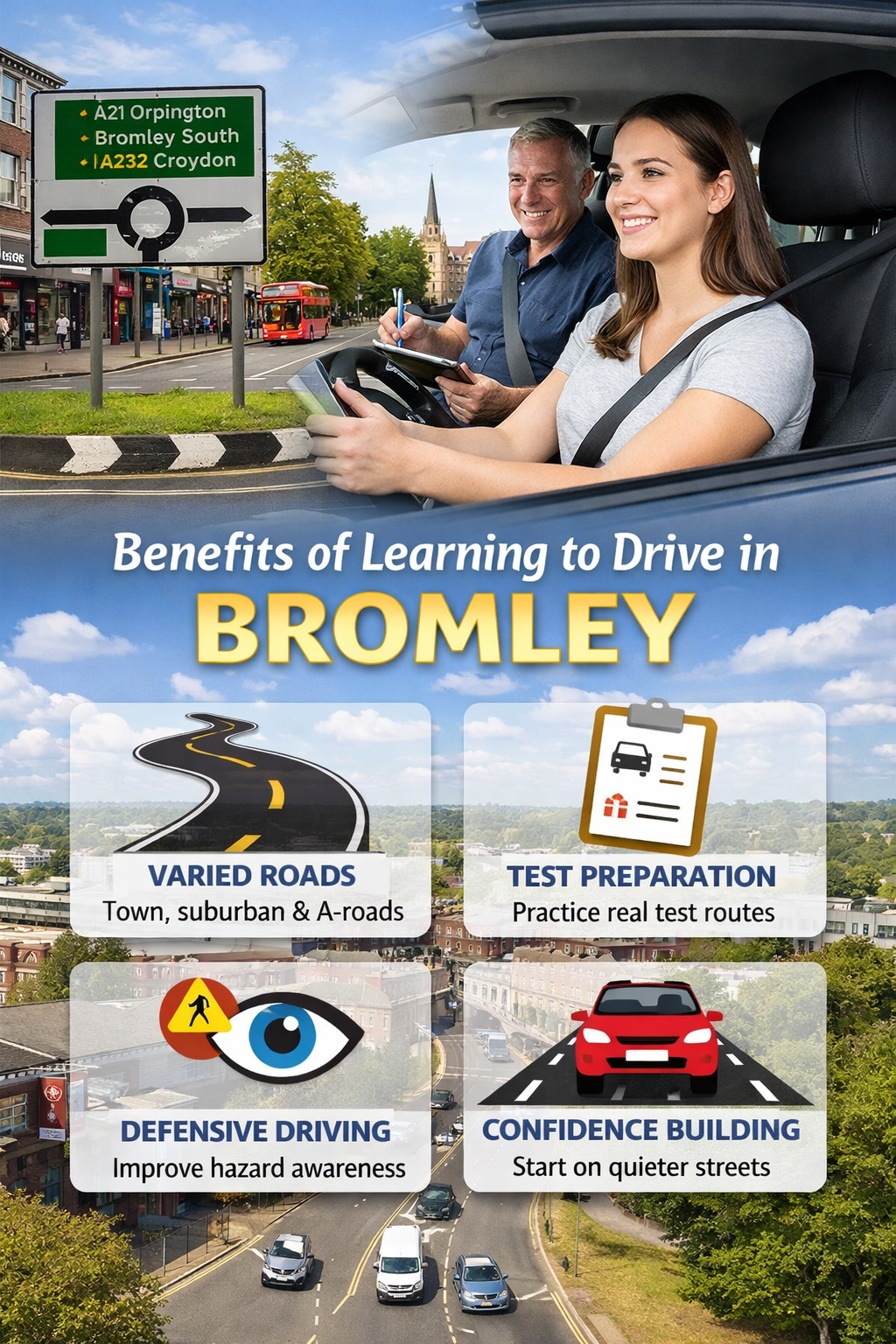 Learning to drive in Bromley means getting experience with a wide variety of roads and traffic situations.
You may be dealing with busy junctions and roundabouts one minute and quieter residential roads the next. That’s why good driving lessons should prepare you to deal with different situations rather than simply teach you how to follow a particular test route.
Here’s what to consider if you’re learning to drive in Bromley.
What should you learn during driving lessons?
Driving lessons aren’t just about controlling the car.
As you progress, you should be developing the ability to:
- Read road signs and markings
- Use mirrors effectively
- Choose appropriate speed
- Position the car safely
- Deal with junctions and roundabouts
- Anticipate hazards
- Deal with other road users
- Make independent decisions
- Navigate unfamiliar roads
Your instructor should gradually reduce the amount of help they give you as your skills develop.
The aim is to become an independent driver, not someone who can only drive when an instructor is telling them what to do.
What is driving in Bromley like?
Bromley offers a mixture of busy urban roads, residential streets and more open stretches of road.
That variety can be useful for learner drivers because it gives you the opportunity to develop different skills.
You may encounter:
Busy junctions
Traffic levels can make some junctions more demanding, particularly at busy times.
These situations give you the opportunity to practise observation, anticipation and making safe decisions without rushing.
Roundabouts
Roundabouts require several skills at once, including:
- Correct lane choice
- Observation
- Speed control
- Positioning
- Signalling
- Judgement
Rather than memorising individual roundabouts, you should learn how to read signs, road markings and traffic so that you can deal with unfamiliar ones as well.
Residential roads
Quieter residential roads are useful for developing basic road skills and dealing with parked vehicles, narrow sections, junctions and changing speed limits.
They’re also useful for building confidence before progressing onto busier roads.
Pedestrian crossings and busy areas
Learners need to become comfortable spotting pedestrians, cyclists and other vulnerable road users and anticipating what they might do next.
Looking well ahead gives you more time to respond safely.
How often should you have driving lessons?
There isn’t one schedule that works for everybody.
However, regular lessons generally make it easier to maintain momentum.
For example, having a lesson every week means you’re regularly practising the skills you’ve already learned. Longer gaps can mean spending part of the next lesson getting back up to speed.
If your schedule allows it, two lessons a week can provide more continuity.
The important thing is finding a frequency that you can maintain consistently.
Can private practice help?
Yes, provided you have an appropriate supervising driver and the correct insurance.
Private practice gives you additional time behind the wheel and can reinforce things you’ve already learned during professional lessons.
It can be particularly useful for gaining experience with:
- Junctions
- Roundabouts
- Parking
- Different speed limits
- Busy traffic
- Independent navigation
However, private practice shouldn’t replace professional instruction.
Your instructor can identify mistakes and habits that a friend or family member may not notice.
Should you learn in a manual or automatic?
This is a personal choice.
An automatic car removes the need to operate a clutch and manually change gears. For some learners, this means they can concentrate more of their attention on observation, traffic and decision-making.
A manual licence gives you the ability to drive both manual and automatic cars.
If you already know that you want to learn in an automatic, there’s no need to learn in a manual simply because you think it’s what you’re supposed to do.
The important thing is choosing the type of training that suits your circumstances.
How long does it take to learn to drive?
There’s no fixed number of lessons that applies to every learner.
Some people have previous driving experience. Others are starting completely from scratch.
Your progress can be affected by:
- How frequently you have lessons
- Private practice
- Previous experience
- Confidence
- How quickly you develop new skills
- The areas you find particularly difficult
It’s better to judge your progress by your ability rather than by the number of lessons you’ve completed.
When should you take your driving test?
Don’t book your test simply because you’ve reached a certain number of lessons.
You should be approaching the point where you can drive safely and independently without constant prompts.
That includes being able to:
- Deal with unfamiliar roads
- Make appropriate decisions
- Maintain suitable speed
- Use effective observation
- Handle junctions and roundabouts
- Complete manoeuvres safely
- Follow directions independently
- Recover sensibly from minor mistakes
Your instructor should give you an honest assessment of whether you’re ready.
Preparing for the Bromley driving test
If you’re taking your test at the Bromley test centre, practising in the surrounding area can help you become familiar with the types of roads and traffic conditions you’ll encounter.
However, don’t rely on memorising a test route.
Routes can vary, and the ability to deal with an unfamiliar road is an important part of becoming an independent driver.
It’s much more useful to understand how to deal with junctions, roundabouts, speed changes and hazards than to memorise a sequence of turns.
For more information, see our guide to the Bromley driving test centre and what to expect.
Choosing a driving instructor in Bromley
The instructor you learn with can make a big difference to your experience.
Look for someone who:
- Is a qualified Approved Driving Instructor (ADI)
- Explains things clearly
- Gives constructive feedback
- Adapts lessons to your ability
- Helps you become independent
- Doesn’t rush you towards your test
- Is reliable and professional
Reviews can also be useful, but don’t choose an instructor on reviews alone.
The cheapest lesson isn’t necessarily the best value if you’re not progressing.
Nervous about learning to drive?
It’s completely normal to feel nervous when you start learning.
You don’t need to be confident before your first lesson.
Confidence usually develops as you gain experience and begin to understand how to deal with different situations.
If something is causing you particular difficulty, tell your instructor. A good instructor should be able to break difficult situations down and build your experience gradually.
How to get the most from your lessons
You can make your lessons more productive by:
Practising regularly
Try to avoid unnecessarily long gaps between lessons.
Asking questions
If you don’t understand why you’ve been asked to do something, ask.
Learning from mistakes
Making mistakes is part of learning. Understand what happened and what you can do differently next time.
Practising between lessons
If you have access to a suitable car and supervising driver, additional practice can reinforce your lessons.
Working towards independence
Don’t measure progress only by how well you can follow instructions. The real milestone is being able to make safe decisions yourself.
Learning to drive in Bromley
Good driving lessons should give you more than the ability to pass a test.
They should help you become comfortable dealing with different roads, traffic conditions and situations without someone sitting beside you telling you what to do.
If you’re learning in Bromley, make the most of the variety of roads available to you and focus on developing skills that will still be useful long after you’ve passed your test.
If you’re looking for automatic driving lessons in Bromley, you can find more information about our lessons and the areas we cover on our main Bromley driving lessons page.