Most learners can repeat the headline figure, but far fewer understand how the UK theory test is marked. That gap matters. When you are trying to work out how many questions in the theory test you will face, the number alone tells only half the story. The car theory test has two parts, and you must pass both. Part 1 gives you 57 minutes for 50 multiple-choice questions: 47 drawn from 14 topic areas and 3 based on a silent video clip you can replay as often as you like. Part 2, hazard perception, is scored on completely different logic, with a very different tolerance for a bad run.
This analysis breaks down the question count, timing, pass marks and scoring rules section by section. You will learn what the multiple-choice questions cover, how the three video-clip questions work, why hazard perception is not marked like a normal quiz, and what the 86 per cent accuracy versus 58.7 per cent tolerance means. We will also cover what each section tests, how that should change your revision, and the Bromley-specific booking, preparation, validity and retake rules that catch learners out. By the end, you will revise for the right half.
The Short Answer: How Many Questions Are in the UK Theory Test?
The car theory test has 50 multiple-choice questions to answer within 57 minutes, followed by a hazard perception section scored out of 75. Both parts must be passed to pass the test overall.
Pass marks are 43 out of 50 for multiple choice (86%) and 44 out of 75 for hazard perception (about 58.7%).
This guide covers the car theory test only. Motorcycle and LGV categories run their own formats.
Most learners know the headline question count. Far fewer realise the two halves are marked on completely different logic, with very different tolerances for a bad run.
Booking costs £23, and the pass certificate is valid for two years, so the practical test must be passed inside that window. For a wider look at what you might be asked, see driving test questions explained.
| Section | Questions | Time | Pass mark | Pass % |
|---|---|---|---|---|
| Multiple choice | 50 | 57 minutes | 43 | 86% |
| Hazard perception | Not question-based | Same appointment | 44 of 75 | ~58.7% |
Part 1: How Many Theory Test Questions Are Multiple Choice?
Part 1’s 50-question, 57-minute format carries that 86 per cent bar, for the wider picture, see What About the Theory Test?
That block splits 47/3 across topic questions and a video clip, as the Short Answer table shows. Before the real section begins, you get instructions and a practice question, purely to familiarise yourself with the on-screen controls. Throughout, you can flag questions, change any answer, revisit flagged items, and finish early rather than use the full 57 minutes.
The tolerance is the catch. With only seven wrong answers permitted across all 50, one careless run through a weak topic can be enough to fail. Questions are drawn from the Official Highway Code, the Official DVSA Guide to Driving and Know Your Traffic Signs, so revision should follow those sources rather than third-party question banks.
Inside the 47 Topic Questions: What the 14 Topic Areas Cover
The 47 topic questions carry the broadest revision burden. Their ground is deliberately wide rather than deep, sampling all 14 official topic areas, from road signs and legal requirements through to vehicle safety and vulnerable road users, rather than going deep on any single one. (The DVSA publishes the full topic list at safedrivingforlife.info.)
That breadth is the real risk. Ignore one whole topic area and you carry an invisible gap into the test, because each of the 14 areas is sampled lightly instead of examined thoroughly.
The DVSA warns that third-party practice questions differ from the real thing, and that memorised answers collapse the moment the wording shifts. Understand the rule, not the answer.
A tactic that fits this structure: cover all 14 areas lightly, then go deep on the two or three where your practice scores stay consistently weakest. For a structured route through that groundwork, see preparing for the theory test in Bromley.
The 3 Video-Clip Questions and How They Are Scored
Three of those 50 sit inside a short, silent video clip, still multiple choice, still one right answer. You can watch it as many times as you like during the test. There is no limit on replays and no penalty attached to them.
On scoring, the misunderstanding is widespread. The three video-based questions carry no separate pass mark. The official pass marks list only two scored components, multiple choice and hazard perception, so these three sit inside the same 43 out of 50 threshold as every topic question.
In practice, there is no separate video test to fail. Treat them as part of the same 50-question total. Because the footage can be replayed freely, rushing it is a self-inflicted error.
Part 2: How the Hazard Perception Section Is Scored Differently
By contrast, the hazard perception section is not made up of questions in the traditional sense. It is a series of video clips where you click when you spot a developing hazard. Hazard perception: 75 marks, 44 to pass (the ~58.7% already in the summary table).
That is far more forgiving in percentage terms than the multiple-choice mark of 86 per cent. This asymmetry is what this article turns on. There is also a break of up to three minutes between the two parts, worth knowing if pacing worries you. Since this half tests anticipation, utilizing technology to enhance learning can help sharpen that instinct.
One caveat: the number of clips and the per-hazard scoring mechanics are not confirmed here. Check the official DVSA hazard perception guidance directly before trusting any app’s version of how clips or individual hazards are marked.
A forgiving percentage does not make the section forgiving. It remains a hard pass or fail: 43 out of 75 fails the whole test, because both parts must be passed.
The Real Story: 86 Per Cent Accuracy vs 58.7 Per Cent Tolerance
The gap the table shows is stark in practice: roughly 41 per cent of hazard perception marks can be lost, against just 14 per cent of multiple-choice marks.
The reason is what each half measures. Multiple choice tests knowledge, where one answer is right and the rest are wrong, so accuracy is everything. Hazard perception tests scanning and anticipation, where misses are expected even from experienced drivers.
The bad-run maths follows. Seven wrong multiple-choice answers still passes; the eighth fails. Hazard perception tolerates 31 dropped marks.
So the halves do not average. Strong scanning cannot rescue shaky knowledge, and solid revision cannot rescue poor anticipation.
That asymmetry is the most useful fact in this article. See our guide to mastering the theory test: knowledge is power for where to put the revision hours.
What Each Section Is Actually Testing
The asymmetry only becomes useful once you know what each section actually measures, because the two halves test genuinely separate skills.
The multiple-choice section examines retained, usable knowledge: rules, signs, priorities and legal requirements a driver must recall without hesitation.
The hazard perception section examines perception and anticipation. A parked car sitting still is a potential hazard; the moment it signals and pulls out, forcing you to slow or steer, it becomes a developing hazard. That transition is the skill the section is built around.
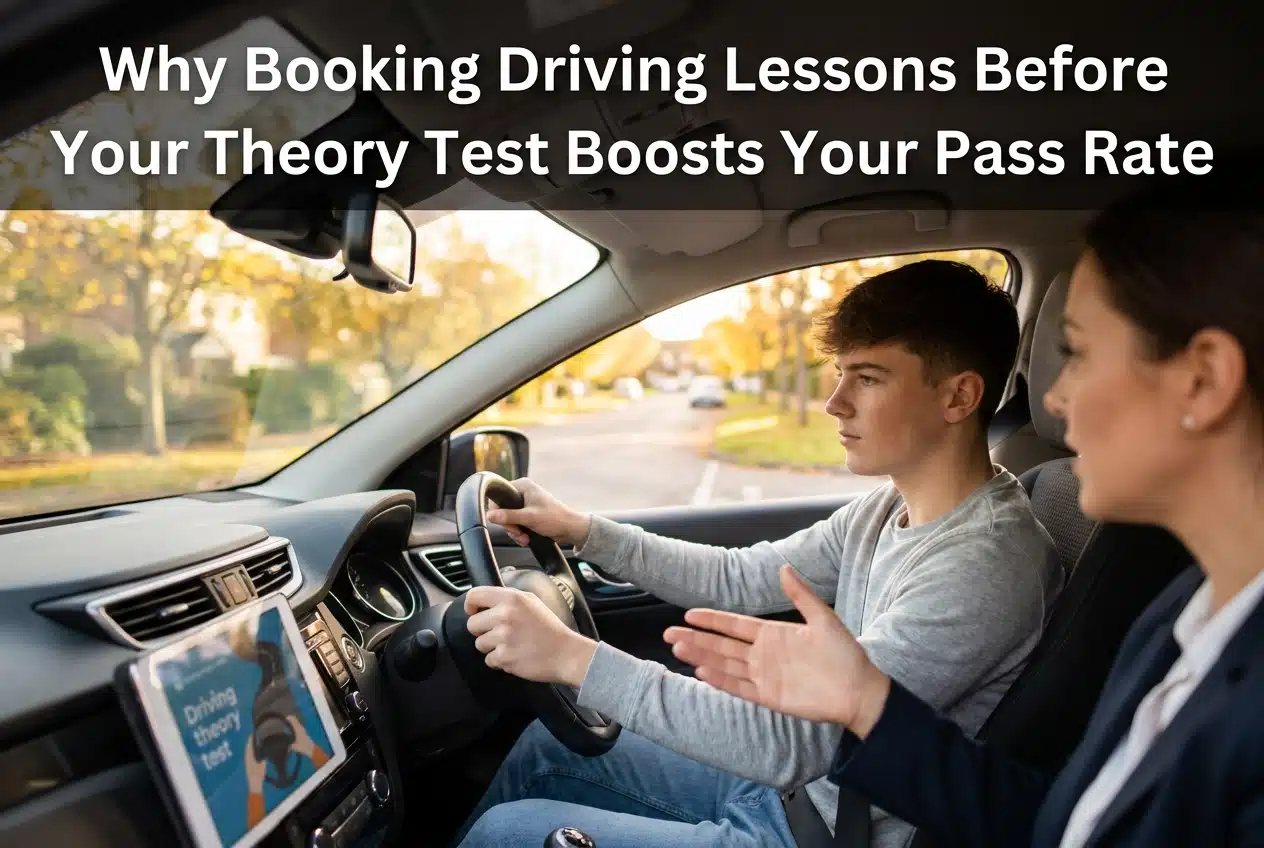
Because the skills are separate, learners with excellent road sense still fail the knowledge half, and revision alone will not fix scanning habits. The DVSA’s position is that understanding beats rote learning, since understanding transfers from an app into a live situation, which is why booking lessons before your theory test boosts your pass rate rather than adding more practice questions.
Both connect to real driving. The theory half protects you during the practical test and afterwards, while hazard perception habits show up in how early you react on Bromley’s busier roads.
What This Means for How You Revise
Because the two halves test different skills, a 50/50 revision split wastes time. Give multiple choice the larger revision share. Aim for a comfortable margin above 43, not 43 exactly; test-day nerves can cost marks that practice scores do not predict. A high practice score from memorised answer patterns is not readiness. If you cannot explain the rule behind each answer, you have not learned it.
For hazard perception, practise reacting to developing hazards rather than clicking speculatively, check the official DVSA hazard perception guidance for how individual clips are marked. Free DVSA practice tests and video clips cover the generic ground, which is why a local school’s value is practical context, such as the real-road skill mapping in The DVSA’s 27 Driving Skills Framework: What It Means for Your Lessons With EL’s. Remember the two-year certificate window: passing theory early only helps if you book and pass the practical inside it.
- The week before: run timed full-length practice, review your flagged weak areas, and read calmly through the official source material once more.
For Bromley Learners: Booking, Preparation and Local Context
The numbers above hold true regardless of postcode. What varies is how you prepare for them, and that is where a Bromley learner benefits from local guidance rather than another generic question bank.
EL’s Driving School has taught in Bromley since 2004, covering BR1, BR2, BR3 and BR4 as well as the surrounding south-east London areas. Instructor-led theory support works best alongside the official DVSA materials, because an instructor can explain the rule behind the answer rather than simply confirming that you chose correctly.
Premium automatic lessons and online lessons let you build theory knowledge and practical skill in parallel, instead of treating them as two separate projects. Practical test preparation resources then keep the two-year certificate window under control, so a passed theory test is converted into a full licence rather than left to lapse.
If you would prefer to plan that route with someone local, you can contact EL’s Driving School to talk through booking and preparation.
Rules That Catch Learners Out: Validity and Retakes
Whatever route you take to preparation, two administrative rules decide whether that effort actually counts.
The two-year window covered above is the first rule.
The all-or-nothing retake rule (full test, minimum three working days’ wait) is the second.
Cost compounds quietly: the £23 fee is charged on every attempt, so a learner who clears multiple choice but keeps failing hazard perception pays for the whole test each time.
Every figure here reflects current GOV.UK guidance for the car theory test. Motorcycle, lorry and bus categories follow their own formats and rules, so check the official guidance for your vehicle rather than assuming these transfer.
Conclusion: Revise for the Right Half
With the rules clear, the figures in the opening table shape your revision. Three habits follow. Revise to a comfortable margin above 43 rather than to the pass mark itself. Treat the three video questions as part of the same 50, not a separate test. And check the official hazard perception guidance for clip mechanics before trusting any app’s version.
Book the practical in good time to use the two-year window.
If you would rather have local, instructor-led preparation than another question bank, EL’s Driving School has taught in Bromley since 2004 and covers BR1 to BR4.