Picture this: you pass your theory test, then sit in the car and realise you cannot remember what a sign meant. Or you drive beautifully but freeze on a scenario question. That gap happens when theory and practical feel like two separate jobs. This post is here to close it.
A smart theory test revision plan should run alongside your driving lessons, not against your test date. Instead of cramming facts in isolation, you will map each topic to the lesson stage where it makes sense.
You will learn why theory and practical are one job, the test facts you need, and what to set up before week one. Then we will walk through weeks 1 to 4, 5 to 8, and 9 to 12, covering cockpit basics, junctions, signs, sharing the road, independent driving, and test standard. You will also see worked examples of the lesson-linked habit, how to share progress with your instructor, official practice versus answer drilling, when to book your theory test, common traps, and why to start with your next lesson, not your test date. Ready? Let’s build a rhythm that serves both tests.
Why Theory and Practical Are One Job, Not Two
Most learners fall into one of two traps. Revise only against your test date and the material goes cold before you are behind the wheel. Drive only, and you never build the vocabulary to answer scenario questions.

The sequence matters: you must pass the theory test before you can get your full licence, and in practice this means passing it before your practical test, so revision that ignores your lessons fights that order.
DVSA’s own guidance recommends linking study to real driving experience, like recalling where you saw a road sign. Lesson-linked revision is a natural extension of that tip, it is the school’s own method, not a separate DVSA rule.
When your revision topic matches your next lesson, one block of study time serves both tests. The test facts here are official; the calendar is EL’s Driving School’s own method. Our guide to driving test questions shows how the two overlap.
The Test Facts You Need Before You Plan Anything
Your theory test is two parts sat in one appointment: a multiple choice section, then a hazard perception section, with a short break in between.
The multiple choice half is 50 questions in 57 minutes. Of those, 47 come from 14 key topic areas, and 3 are based on a single video clip. You need 43 out of 50 to pass.
The fee is £23. Check the current retake fee on GOV.UK before rebooking. That is a practical reason to build a plan rather than gamble on one cramming weekend.
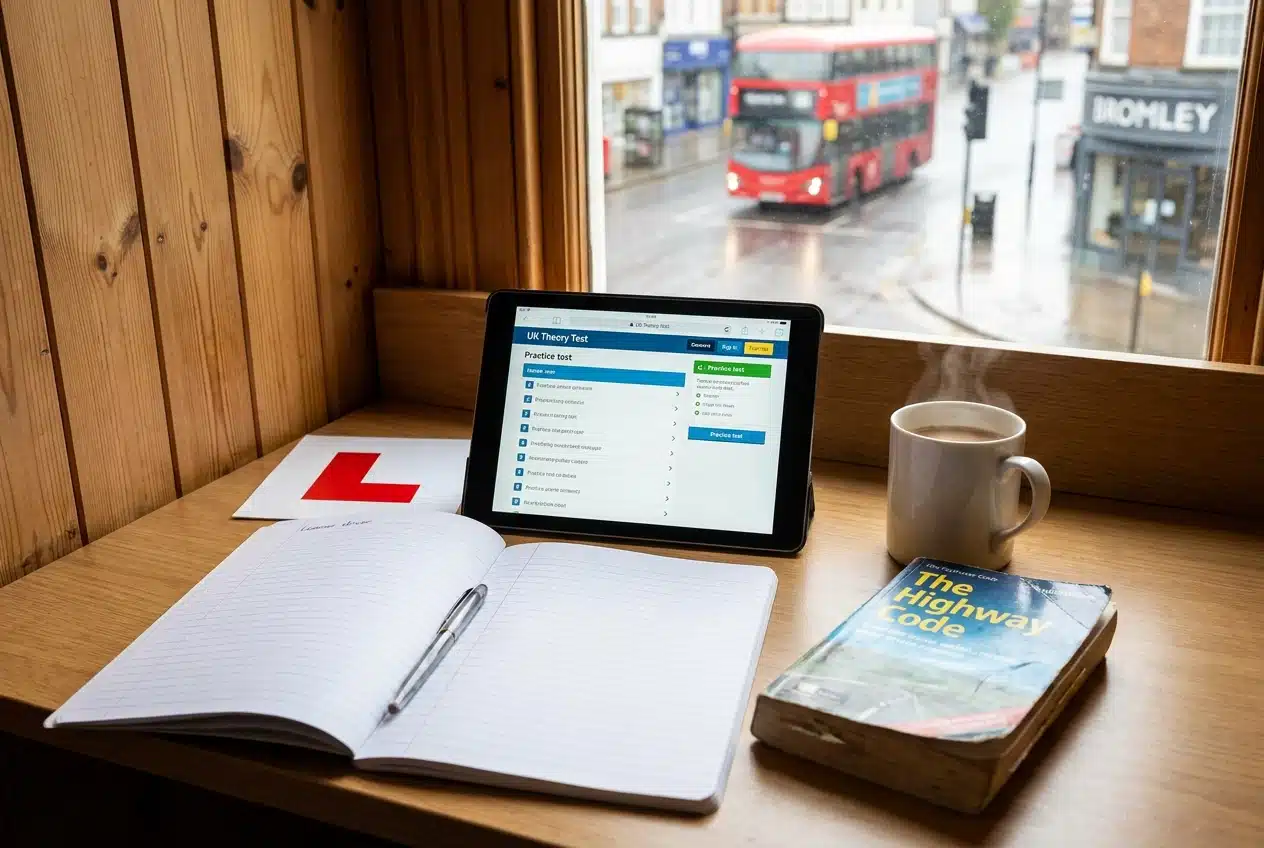
Every question is drawn from three official books: The Highway Code, Know Your Traffic Signs, and Driving: the Essential Skills. Revise anything else and you are revising the wrong material.
It is worth reading What About the Theory Test? before you build anything.
What to Have in Place Before Week One
Set up the official sources first: the three books, plus the official DVSA Theory Test Kit for PC or Mac that GOV.UK points learners towards. Free official practice exists, so nobody starts from zero.
Fix a recurring slot, not a daily target. In our experience at EL’s Driving School, a 20 to 30 minute revision block the evening before your next lesson keeps material warmer than a longer session on a random day.
Start an error log. Every wrong answer gets one line: the topic, and why the correct answer is correct. That becomes your lesson agenda.
Check lesson frequency with your instructor and adjust the spacing to match. On automatic or online lessons, front-load theory in the early weeks.
Weeks 1 to 4: Map Cockpit, Controls and Basic Signs
Your first four weeks are about the car itself: the cockpit drill, moving off and stopping, mirrors, steering, then simple junctions on quiet Bromley roads. If you want a head start, read Understanding Your First Driving Lesson before you begin.
Line your revision up with that. Study the topics in the official books that cover vehicle checks, warning lights, tiredness and paperwork, all things your instructor raises anyway.
Add road and traffic signs, but only signs you have genuinely passed. Note the street or junction where you saw each one; the DVSA recommends linking a sign to where you saw it to fix its meaning.
Leave hazard perception alone for now. It clicks once you can read a road.
Finish each week with a short theory test practice set on those topics, then take your three worst questions to your next lesson.
Weeks 5 to 8: Junctions, Signs and Sharing the Road
Weeks 5 to 8 land mid-course: roundabouts, meeting traffic, crossroads, town driving and busier routes.
Revise the topics in the official books that cover junction rules, safety margins and sharing the road with pedestrians, cyclists and other vehicles, this phase of your lessons is where these rules become daily practice.
Build hazard awareness by narrating. After each lesson, note two hazards you spotted and what you did, then check your response against official guidance. Add your first hazard perception clips here. GOV.UK’s hazard perception clips each contain a developing hazard: something that would make you change speed or direction.
Watch, score, then say out loud in your next lesson what you are looking at. That screen-to-road move is the point.
Review your weeks 1 to 4 error log. Anything still shaky gets five minutes at the start of each session until it clears.
Between lessons, try quiet places near Bromley.
Weeks 9 to 12: Independent Driving and Test Standard
As lessons move into independent driving and mock routes, use your error log to identify any topic areas from the official books you have not yet covered.
Shift theory test practice to full mock conditions: 50 questions, 57 minutes, one sitting. Do flag and return to questions, and rewatch the video questions, because the real test allows both. Treat the score as a diagnostic and log every miss by topic.
Pair each mock with a hazard perception set, looking for a steady pattern rather than one lucky run, and note which clip types keep catching you.
Book when mocks sit consistently above the pass mark and your instructor agrees you are at test standard, not simply when the twelve weeks are up. Check Driving Theory Test Centres: A Local Guide for Bromley Learners before choosing a date.
Worked Examples of the Lesson-Linked Habit
As your mocks settle, these small habits keep theory and driving connected.
Study a no-through-road sign on Tuesday, then on Thursday point out the two you passed and say what each means. That is Know Your Traffic Signs on your route.
Mnemonic reuse: mirror, signal, manoeuvre is already taught in the car. Revise the theory questions behind it using the same words. One set of phrases, two exams.
Hazard narration: watch a clip, then describe the developing hazard in one sentence. In the car, say it aloud before your instructor prompts you. If you can narrate it, you understand it.
Error log as lesson agenda: bring your three worst questions and ask your instructor to cover them in context. A question about following distances becomes a real following distance.
Scenario drill: rewrite one video-based question as something that happened on your last drive. Explaining the answer in your own words proves understanding.
Keep these small and repeatable: a five minute bridge, not a second job. Our guide to tools for learning and retention shows how to make that bridge count.
Shared progress is designed, not improvised: the official DVSA eLearning product lets you link your learning with your instructor or a parent.
Agree a brief handover at the start of each lesson covering what you revised, what confused you, and what you want pointed out on the drive. That ritual is what stops theory and practical drifting apart.
Ask your instructor to name the road features you studied. Revise box junctions an hour before your lesson and the first one you drive through will land better.
Keep the mechanism low effort. A shared note, a message thread or a photo of your error log is enough. Anything longer than the lesson itself gets dropped by week three.
At EL’s Driving School, lesson feedback and progress notes sit in the same loop, so revision and driving plans are reviewed together.
Revisit the split monthly. Strong theory scores with driving behind? Shift the emphasis, and the other way round.
Still weighing up the order of both tests? See why booking driving lessons before your theory test boosts your pass rate.
Official Practice Versus Answer Drilling
Progress sharing only works if the material behind it is sound. In our experience, a high score on a third-party app is not test readiness. The DVSA’s own preparation guidance notes that many products contain questions that differ from the real test, and that learning answers without understanding why they are correct does not transfer to the test or to the road.
Answer drilling builds recognition. Reasoning builds the ability to answer a scenario question you have never seen before, which is what the multiple choice section rewards. Free official practice, a full 50 question, 57 minute mock, plus questions based on a video clip, gives you the format without the distraction of unverified third-party content.
So free official practice gives you the questions; an independent driving school gives you the schedule and the interpretation. That is the gap official material leaves open. This plan sits on top of DVSA materials, deciding what to revise and when, never what the correct answers are.
Treat scores as trend data across several weeks, not a single number to panic about.
When to Book the Theory Test
Treat your mock scores as evidence, not encouragement. As covered in weeks 9 to 12, treat mock scores as a trend, not a single number.
Passing the theory test is a prerequisite for obtaining your full licence, so delaying here has a knock-on effect on your overall timeline, your instructor’s schedule and everything downstream.
Avoid both extremes. Booking months out lets the rhythm go stale; booking a fortnight away forces cramming that undoes the lesson-linked habit you have built. Check test centre availability before committing to a target date.
If the result is not what you wanted, the plan does not need replacing, just re-running. Return to your error log, rebuild the weak topic blocks, and keep the lesson handover going.
Judge readiness on your own evidence, not published pass rates. Your mocks, your hazard scores and your instructor’s view are the measures that actually tell you something.
Common Traps That Break the Rhythm
That booking is only as good as the rhythm behind it. Six habits quietly break it.
- One big push before the test date. It feels efficient; it is the fastest way to forget material before you ever use it in the car.
- Skipping the dull topics. Certain topics, anything not directly covered in your first weeks of lessons, are easy to postpone and just as easy to be examined on.
- Treating hazard perception as a game. Clicking fast is not the skill; reading a developing hazard early is, and that improves only with deliberate practice.
- Letting the plan drift when lessons move. If a lesson is rearranged, move the revision block with it instead of dropping it.
- Reading a strong mock score as test readiness. It is one data point; understanding matters more than recall.
- Revising alone for months. Without the handover with your instructor, the two jobs quietly separate and the method collapses.
Catch these early and the rhythm survives.
Start With Your Next Lesson, Not Your Test Date
Anchoring revision to your next lesson keeps one block of study time working for both tests, a natural extension of the lesson-linked method described above.
Try three things this week. Pick a fixed revision slot, around 20 minutes works well in our experience, the evening before your lesson. Write your error log, one line per wrong answer and why the right one is right. Then ask your instructor to point out the road features you revised.
Treat the official materials as your question bank, and let the week-by-week rhythm decide what to revise when. Book the theory test once your mocks sit consistently above the pass mark, not because the calendar says so.
Your next step is simple: book your next lesson, or ask your instructor to align this week’s topic with this week’s revision. EL’s Driving School can fold theory support into your practical plan, including automatic lessons and online sessions.
Conclusion
That rhythm turns every lesson into revision and every revision block into better driving. If lessons move, move the study block with them. Do not revise alone for months.