Passing your driving test is one of the most exciting milestones you can achieve, but let’s be honest, it can also feel overwhelming. With so much to prepare for, knowing exactly what to expect makes all the difference between walking out with a pass certificate or booking another attempt.
One of the biggest areas where learner drivers struggle is understanding the full range of driving test questions they will face. From the multiple-choice theory test to the practical show me tell me questions, there is more to prepare for than many beginners realise. The good news is that with the right guidance, these questions are completely manageable.
In this guide, we break down every type of question you will encounter during your driving test journey. You will learn what the theory test covers, how to tackle hazard perception, and exactly what the examiner expects when they ask you to demonstrate basic vehicle safety checks. Whether you are just starting out or gearing up for your test date, this post gives you the clear, structured knowledge you need to pass first time.
What Are the Two Types of Driving Test Questions?
Not all driving test questions are created equal, and confusing the two main types is one of the most common mistakes learner drivers make. There are two distinct categories you must prepare for separately: theory test multiple-choice questions and show me/tell me vehicle safety questions. Each is assessed differently, carries different consequences, and demands a different revision approach.
Theory test questions evaluate your knowledge in isolation. Sitting at a computer terminal at a DVSA test centre, you work through 50 multiple-choice questions drawn from a DVSA-approved question bank, covering topics such as road signs, the Highway Code, and safe driving principles. You also complete a hazard perception component. None of this takes place near an actual vehicle.
Show me/tell me questions are a different challenge entirely. Drawn from a bank of 21 questions covering vehicle safety, one is asked verbally before you move off, and one is asked while you are actively driving. These questions assess whether you can apply practical vehicle knowledge in a real-world context, not simply recall a fact.
The consequences of getting each wrong are also very different. Failing your theory test means you cannot book or sit your practical test at all; your certificate must be valid before a practical date is confirmed. Getting a show me/tell me question wrong, however, earns only a minor driving fault rather than an automatic failure, as confirmed by current DVSA guidance on vehicle safety questions.
This guide addresses both question types in full. You will find theory test content covered first, followed by a detailed breakdown of show me/tell me questions, and then a practical revision strategy to bring both together before test day.
UK Theory Test Questions: What to Expect in 2026
Now that you understand the two types of driving test questions, it is time to examine the theory test in detail, because understanding its exact structure is the foundation of every effective revision plan.
The Theory Test Format
The theory test consists of two separate parts, both completed in a single sitting. The first part presents 50 multiple-choice questions on a touchscreen computer. You have 57 minutes to answer them, though most candidates finish in 20 to 30 minutes. Questions can be flagged and revisited before you submit, which is a useful tactic when you are unsure. The pass mark is 43 out of 50, meaning you can drop no more than seven marks. The second part is the hazard perception test, made up of 14 CGI video clips containing 15 scorable hazards in total. You must achieve a minimum score of 44 out of 75 to pass. Critically, both parts must be passed in the same sitting. Passing only one and failing the other means retaking the entire test. You can book your theory test only through the official GOV.UK service at a fee of £23.
The 14 DVSA Question Categories
The multiple-choice questions are drawn from 14 official categories. Every learner must cover all of them:
- Alertness (observation, anticipation, concentration)
- Attitude (courtesy, consideration, priority)
- Safety and your vehicle (fault detection, safety equipment)
- Safety margins (stopping distances, speed, separation)
- Hazard awareness (anticipation, attention, speed management)
- Vulnerable road users (pedestrians, cyclists, children)
- Other types of vehicle
- Vehicle handling (weather conditions, night driving)
- Motorway rules (joining, leaving, smart motorways)
- Rules of the road (speed limits, parking, lane discipline)
- Road and traffic signs (warning, regulatory, informational)
- Documents (licence, insurance, MOT, registration)
- Accidents (first aid, reporting, breakdowns)
- Vehicle loading (passengers, loads, towing limits)
Motorway rules, towing regulations, smart motorway procedures, and accident protocols are among the most commonly failed categories, largely because learner drivers have no direct experience of these situations before their test.
Why the DVSA Question Bank Is Your Only Reliable Source
The multiple-choice questions are drawn from a fixed, licensed bank of approximately 700 to 721 DVSA-approved questions. This bank is finite and officially published, which means every question you could face is already available for revision. Revising directly from this approved bank is the only fully reliable preparation method. Third-party question sets may approximate DVSA content, but they are not the authoritative source and may include inaccurate wording, outdated scenarios, or questions that simply do not appear in the official bank. For comprehensive guidance on what to know about the UK driving theory test in 2026, always cross-reference official sources.
Highway Code Updates That Directly Affect Your Test
The 2022 to 2023 Highway Code revision introduced changes that now feed directly into theory test questions. The most significant is the formal hierarchy of road users, which places pedestrians first and cyclists second. This hierarchy underpins updated rules on cyclist road positioning, confirming that cyclists may ride in the centre of a lane in certain conditions. Updated guidance also requires drivers to leave a safe passing distance of at least 1.5 metres when overtaking cyclists at speeds up to 30 mph. Stopping distance questions appear across multiple categories. At 30 mph, total stopping distance is 23 metres. At 70 mph, it extends to 96 metres. In wet conditions, these distances double; on ice, they can multiply by up to ten. These are direct exam topics and must be memorised precisely.
How Hazard Perception CGI Clips Work
Each CGI clip runs for approximately 60 seconds, filmed from a driver’s perspective. Scenarios include night driving, adverse weather, residential streets, and rural roads. Each clip contains either one or two developing hazards, and the scoring window opens as a hazard begins to develop, then closes once it is fully formed. Clicking early scores up to 5 points per hazard; clicking late can score as low as 1 point; missing it entirely scores zero. To pass, you need roughly an average of 3 points per hazard across all 15.
The cheat detection system is non-negotiable. If the software detects rapid, repetitive, or rhythmic clicking on any clip, it awards zero for that entire clip. The correct approach is a single, well-timed click the moment a hazard first begins to develop. Static objects already present in the scene and not developing into a hazard should never trigger a click. Practise responding naturally and decisively rather than clicking in patterns.
Show Me Tell Me Questions: The Full 2026 List and Model Answers
The practical driving test includes two vehicle safety questions, collectively known as the “show me, tell me” section. One tell me question is asked verbally before the engine starts, requiring a spoken explanation of how you would check or identify a fault with a specific vehicle component. One show me question is asked while you are on the move, requiring a physical demonstration of a vehicle control. Both questions are drawn from the current DVSA official list, and answering incorrectly earns one minor driving fault rather than an automatic test failure. You can accumulate up to 15 minor faults before failing, so this section is genuinely low-stakes but absolutely worth mastering to protect your overall scorecard.
The Full 2026 Tell Me Questions and Model Answers
There are 14 tell me questions on the current DVSA list. Your examiner will ask one at random. Study each answer until it becomes automatic.
- Brakes working before a journey: Explain that you test the brakes as you move off. They should feel firm underfoot, not spongy, and the car should not pull to one side.
- Tyre pressure: Describe locating the recommended pressures in the manufacturer’s handbook. Check with a reliable pressure gauge when the tyres are cold, adjust accordingly, then refit all valve caps including the spare.
- Head restraint adjustment: State that the centre of the head restraint should sit at least level with the top of your ears and as close to the back of your head as is comfortable.
- Tyre tread depth and condition: Explain that the legal minimum is 1.6mm across the central three-quarters of the tyre and around the full circumference. Describe checking for cuts or bulges on the sidewalls using a tread depth gauge.
- Headlights and tail lights: Describe turning on the lighting switch, activating the ignition if required, and then walking around the vehicle to confirm all lights are functioning.
- ABS fault: State that a warning light will illuminate on the instrument panel if the anti-lock braking system has a fault.
- Direction indicators: Describe activating the hazard warning lights and walking around the vehicle to confirm all four corners are flashing correctly.
- Engine oil level: Explain waiting until the engine is cold, then locating the dipstick under the bonnet. Withdraw it, wipe it clean, reinsert it fully, withdraw again, and check the level sits between the minimum and maximum markers. Top up with the correct oil specification if required.
- Engine coolant level: With the engine cold, locate the coolant reservoir and check the level against the min and max markers on its side. Top up with the correct coolant and water mix if the level is low.
- Brake fluid level: Locate the brake fluid reservoir near the master cylinder at the rear of the engine bay and confirm the level falls between the minimum and maximum markers. A low level may indicate a leak or worn brake pads.
- Windscreen washer fluid: Open the bonnet, locate the reservoir marked with a windscreen symbol, and confirm it is topped up to the indicated level.
- Power-assisted steering: Before starting the engine, turn the steering wheel and note the resistance. Start the engine and turn the wheel again. The resistance should reduce noticeably, confirming the system is working.
- Windscreen clear and demisters: Describe using the front and rear demister controls alongside the wipers to ensure the windscreen is clear and free from obstruction as required by the Highway Code.
- Horn: Simply state: “Switch on the ignition, then press the centre of the steering wheel.”
For a visual walkthrough of these answers using a 2026 vehicle, the official DVSA tell me questions guide on YouTube is a useful supplement to this written revision.
The Full 2026 Show Me Questions and Model Answers
There are 7 show me questions on the current DVSA list. One will be asked while you are driving. Practice locating each control with minimal distraction before your test day.
- Wash and clean the rear windscreen: Toggle the appropriate section of the right-hand indicator stalk to activate the rear washer and wiper. Keep both hands on the wheel and use only your fingers on the stalk.
- Wash and clean the front windscreen: Pull the right-hand indicator stalk toward you with an outstretched finger while maintaining your steering grip.
- Switch on dipped headlights: Rotate or move the lighting control to the dipped headlight symbol, keeping your eyes on the road throughout.
- Operate the rear demister: Press the rear demister button, typically located on the centre console or dashboard. Keep hands on the wheel.
- Adjust the headlights: Use the headlight levelling dial near the lighting switch to demonstrate adjustment. Confirm the control’s location to the examiner.
- Sound the horn: Press the centre of the steering wheel.
- Open and close a front window: Operate the electric window switch on the door panel using one hand while keeping the other on the steering wheel.
The RAC’s comprehensive show me, tell me guide provides additional detail on what examiners expect during each demonstration.
Automatic Car-Specific Guidance
If you are taking your test in an automatic vehicle, the show me, tell me question list remains the same. However, several answers require slight adaptation. Any question that references clutch fluid is not applicable to a modern automatic, which has no clutch pedal. The power-assisted steering question is answered identically regardless of transmission type. If a question touches on gears, describe the selector positions relevant to your vehicle: P for park, R for reverse, N for neutral, and D for drive, rather than describing manual gear engagement. The brake check answer is identical for both transmission types; apply the brakes gently as you move off and confirm there is no sponginess or pulling. If you are unsure how any question applies to your specific automatic vehicle, your driving instructor can confirm the exact phrasing examiners expect.
The Most Common Mistakes to Avoid
Understanding the question format prevents the errors that cost candidates easy marks. First, vague answers are the most frequent problem. Saying “I would check under the bonnet” without naming the dipstick or identifying the coolant reservoir is insufficient. Examiners expect precision. Second, physically demonstrating a tell me question wastes time and signals poor preparation. Tell me questions require words only; opening the bonnet or pointing at components is unnecessary. Third, hesitating during a show me question while driving creates a genuine safety concern. Practice locating every control by feel so you can respond confidently the moment the examiner asks. Fourth, omitting safety caveats undermines otherwise correct answers. Details such as “check when the engine is cold” for oil and coolant questions, or “refit the valve caps” for tyre pressure, are part of a complete answer and should never be left out.
The Safety Risk Most Learners Miss With Show Me Questions
Most learners preparing for their practical test focus entirely on memorising the correct verbal answers to show me and tell me questions. That focus, while understandable, misses the most consequential risk entirely. The danger is not giving a wrong answer. The danger is what happens when you attempt to physically demonstrate a control while the vehicle is moving.
Here is the fault hierarchy every learner must understand. Getting one or both show me and tell me questions wrong results in just one minor driving fault. A single minor fault will not fail your test. However, if you lose control of the vehicle while attempting to demonstrate a show me answer during the drive, an examiner can record a serious or dangerous fault. That escalation will fail your test outright, regardless of how well you performed during the rest of the drive. The answer itself is almost irrelevant compared to the manner in which you deliver the demonstration.
What Examiners Are Watching For
Understanding what constitutes losing control in this specific context is critical. Examiners are trained to observe unintended swerving, delayed responses to emerging hazards, incorrect steering input, and any prolonged period where your eyes leave the road while you operate a vehicle control. The RAC’s official guidance on show me questions repeatedly instructs learners to keep hands on the wheel at all times and maintain continuous eye contact with the road during every demonstration. Operations involving indicator stalks or wiper controls are designed to be completed with fingertip contact only, precisely because removing your hands from the wheel to fumble with a control is the behaviour examiners are watching for.
The Two Safe Approaches Mid-Drive
When an examiner asks a show me question during the independent driving phase, you have two appropriate options. First, wait for a natural stationary moment, such as a red light or a safe pull-in point, before performing the demonstration briefly and clearly. Second, if the control can be operated with a fingertip movement on a stalk without compromising your steering or attention, demonstrate it smoothly while continuing to scan the road ahead. What you must never do is attempt a demonstration while navigating a complex junction, overtaking, or driving on a busy road where your full attention is non-negotiable.
How Professional Instruction Builds This Skill
Qualified instructors do not treat show me questions as a final-week revision task. From the early stages of lessons, good instruction incorporates physical practice of vehicle controls at low speed in quiet residential streets. This deliberate approach allows learners to build the muscle memory needed to operate controls confidently without diverting visual attention from the road. By the time a learner replicates these conditions on a test route with an examiner present, the physical action should feel automatic rather than unfamiliar.
This is precisely why show me questions remain the most under-prepared aspect of the practical test for the majority of candidates. Learner forums reveal a consistent pattern: candidates who spent hours memorising answers still found their mind going blank when the examiner asked the question during the actual drive. Memorising the answer is passive preparation. Practising the physical demonstration at speed, with someone observing, is the preparation that actually mirrors test conditions. If your lessons have not yet included hands-on practice of every show me control while moving, raise it with your instructor before your test date.
How Theory Test Knowledge Connects to Your Practical Driving Lessons
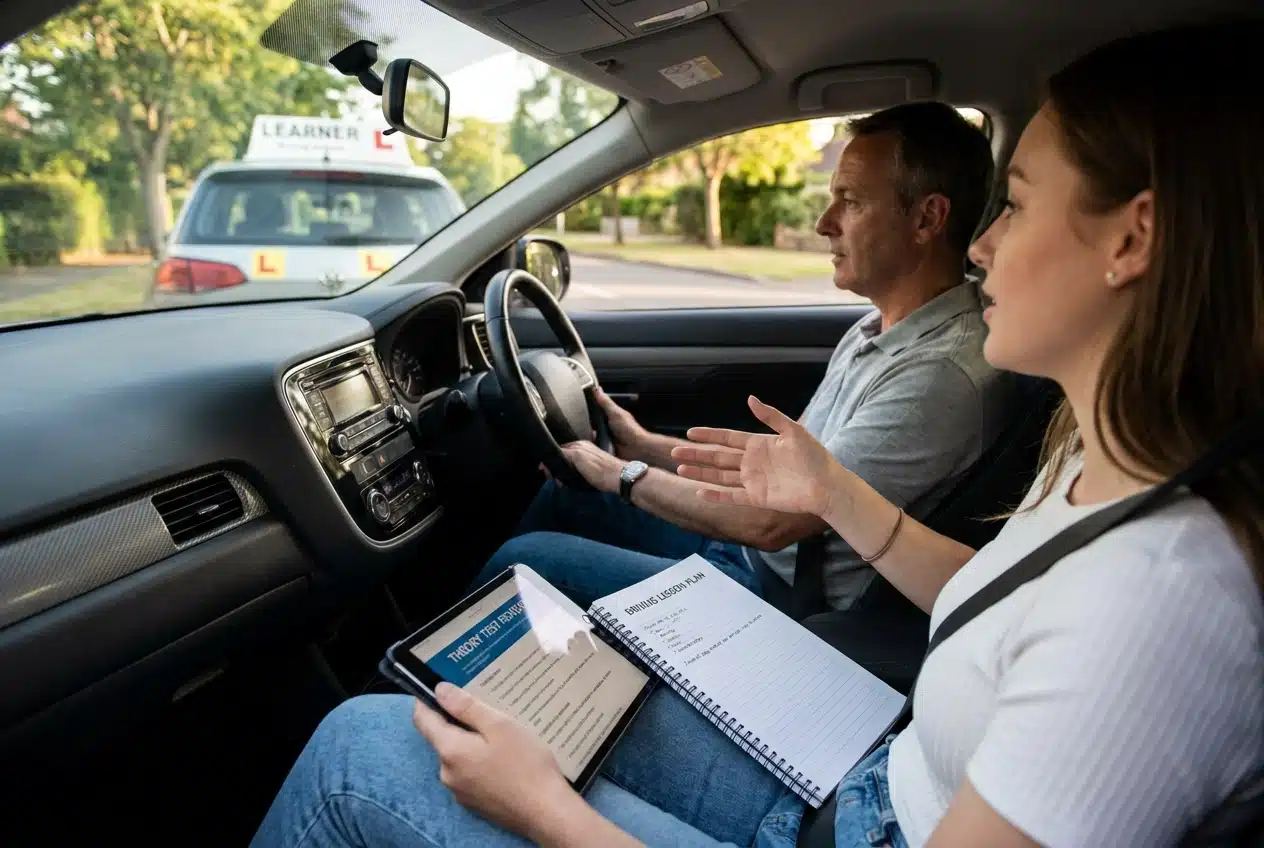
One of the most common mistakes learner drivers make is treating theory revision and practical lessons as two entirely separate tasks. You study your driving test questions at home, pass the theory test, and then mentally switch into “driving mode” when you get into the car. In reality, these two activities reinforce each other directly, and learners who understand that connection tend to progress faster and reach test standard in fewer hours.
Theory Knowledge in Action on the Road
Consider stopping distances. The theory test examines these figures precisely because they govern real decisions you make every time you drive. In wet conditions, braking distances can double compared to dry roads, meaning a gap that feels safe at 30mph may be dangerously inadequate when it has been raining. A learner who has genuinely absorbed those figures, rather than memorised them temporarily for the test, will naturally maintain a safer following distance during lessons without waiting to be prompted. As stopping distances research from the RAC confirms, tailgating is one of the biggest causes of road accidents in the UK and can result in failing your driving test outright.
Road sign knowledge works the same way. When you encounter an unfamiliar junction, the ability to read signage fluently in real time means you respond correctly rather than hesitating or reacting late. Similarly, understanding the Highway Code’s hierarchy of road users, specifically Rules H1 to H3, reshapes how you approach pedestrian crossings and shared-use paths. Knowing that pedestrians have priority in certain scenarios is not just a theory answer; it is a practical decision that happens every few minutes on a typical lesson.
Why Bromley Roads Make This Especially Relevant
The road mix across BR1 to BR4 makes certain theory categories particularly pressing. A-road sections on routes like the A21 and A232 through Bromley and Beckenham test your understanding of national speed limits and overtaking rules. Residential streets throughout the borough bring hazard perception scenarios, parked vehicles, cyclists, and children, directly to life. The numerous roundabouts across the area demand sound knowledge of priority, lane selection, and signalling. High-footfall zones such as Bromley town centre and Beckenham High Street make the hierarchy of road users a live consideration on almost every lesson.
How EL’s Driving School Bridges the Gap
At EL’s Driving School, instructors actively connect theory content to what learners are experiencing on the road in real time. When you encounter a Give Way sign at a quiet residential junction, your instructor will reference what that sign means in theory terms, grounding the correction in something you have already studied. When wet roads extend your stopping distance, the conversation links back to the figures you revised. This approach means knowledge is reinforced in real conditions rather than stored in isolation and gradually forgotten.
The practical benefit is significant. Learners who arrive at lessons with a solid theory foundation use their instruction time for higher-order skills, hazard anticipation, positioning, and independent decision-making, rather than catching up on fundamentals. Fewer corrective explanations are needed, and progress toward test standard accelerates. Given the cost of driving lessons in London, treating theory revision as preparation for your practical lessons, not just for the theory test, is genuinely an investment that pays back in both time and money.
How to Revise Driving Test Questions Effectively
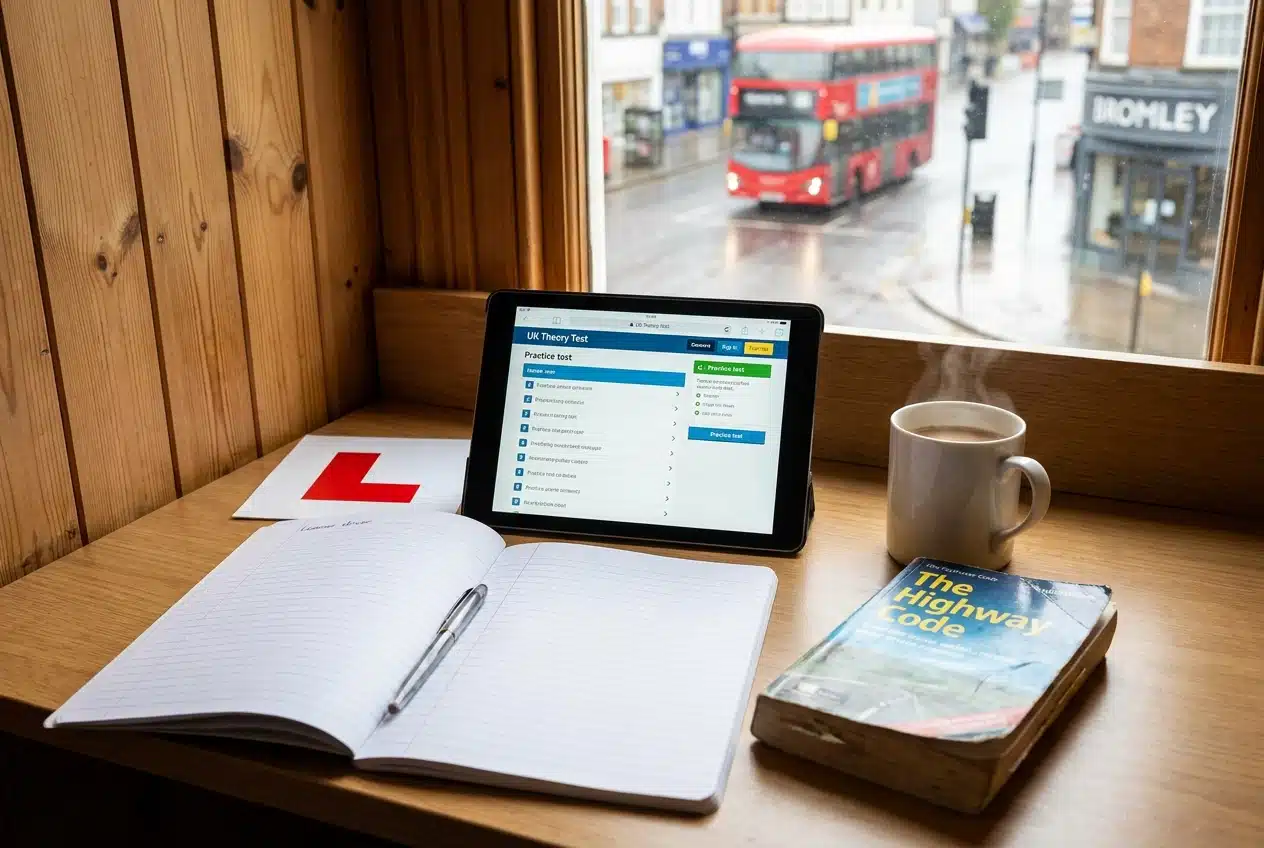
Knowing what to revise is only half the battle. How you revise determines whether that knowledge actually sticks when you are sitting in the test room under pressure. The five strategies below are designed to make your revision as efficient and targeted as possible.
1. Revise Only From DVSA-Licensed Sources
The single most important decision you can make at the start of your revision is choosing where your practice questions come from. The DVSA periodically retires questions from its bank and introduces new ones, meaning unofficial question sets can contain outdated material that will never appear on your actual test. Always look for explicit DVSA licensing before trusting any resource. The government’s own practice theory test page directs learners to approved platforms, including the Safe Driving for Life website for free mock tests. For more comprehensive preparation, apps carrying DVSA licensing, such as those offering 750 DVSA revision questions organised across 15 mock tests, ensure every question you practise reflects the real test bank rather than an approximation of it.
2. Use Mock Tests Diagnostically, Not Just for a Score
Completing a mock test and noting a pass or fail score is the least valuable way to use that tool. The real purpose of mock testing is to identify which of the 14 DVSA question categories you are consistently losing marks in. Those categories cover topics including road signs, motorway rules, stopping distances, vehicle handling, and hazard awareness, among others. Once you know your weak categories, concentrate your revision time there rather than cycling through questions you already answer correctly. This targeted approach removes wasted effort and builds genuine confidence in the areas most likely to cost you marks.
3. Apply Spaced Repetition for Hazard Perception
Cramming hazard perception clips the night before your test does not work. The skill being assessed is pattern recognition, specifically your ability to spot a developing hazard at the earliest opportunity, and that kind of perceptual skill is built through repeated exposure over time, not through a single intensive session. Spreading practice across a minimum of two to three weeks, even at 30 minutes per day, produces far stronger results. Be aware that over-clicking within a single clip will result in a zero score for that clip, so understanding the timing of your response matters as much as recognising the hazard itself.
4. Flag Wrong Answers and Return After 24 Hours
Every question you answer incorrectly in a practice session represents a specific knowledge gap that could cost you marks on test day. Flag those questions immediately and return to them after a gap of at least 24 hours. This gap is deliberate; it forces active recall rather than short-term memory, which is a far more reliable test of whether you have genuinely learned the material. Focus on understanding why the correct answer is right, not just what it is. Knowing why overtaking is dangerous near a junction, for example, makes the rule far easier to retain than bare memorisation.
5. Recognise When You Are Actually Test-Ready
One of the most common causes of avoidable test failures is booking too early, before revision has reached a consistent standard. A reliable benchmark is consistently scoring 46 or above out of 50 across at least three separate mock tests, combined with hazard perception scores above 55 out of 75. Both thresholds sit comfortably above the official pass marks of 43 out of 50 and 44 out of 75 respectively, giving you a meaningful buffer for test-day nerves. If you are regularly hitting those numbers across multiple separate sittings, your revision is doing its job and you are genuinely ready to book your test with confidence.
Final Thoughts: Preparation Reduces Anxiety and Improves Results
Preparing for your driving test becomes far less daunting once you understand exactly what is being tested and why. Theory multiple-choice questions demand structured, category-by-category revision using DVSA-licensed materials, while show me/tell me questions require both confident memorisation of model answers and the ability to demonstrate vehicle checks safely while driving. These are genuinely different skills, and treating them as such is what separates well-prepared candidates from those caught off guard on test day.
For learners taking their test in an automatic vehicle, preparation has an additional layer of nuance. Some vehicle safety checks differ slightly depending on transmission type, and working through these with an instructor who specialises in automatic tuition ensures nothing is left to chance.
EL’s Driving School has been preparing learners across Bromley and south-east London since 2004. As an independent driving school with over 20 years of experience, their dedicated automatic lessons incorporate show me/tell me practice as a standard part of every lesson programme, connecting theory knowledge directly to practical driving from the very first lesson.
Learners who want an instructor who covers show me/tell me questions thoroughly, reinforces theory on the road, and knows the Bromley test routes inside out are encouraged to get in touch with EL’s Driving School today. Confidence on test day starts with the right preparation.